Friday, February 4, 2011

A Side Trip to Durango: January 20 - 22

One of the best parts of cruising is the other cruising people you meet. In an earlier blog I had mentioned we met Paul and Laura from Deep Bay, Vancouver Island, aboard Chirpy when we were in Vallejo, California. For the next three months we hopscotched them down the Baja and into the Sea of Cortez. However, it wasn’t until we were both in Mazatlan that we had the chance to spend some time in each other’s company. (Here is Chirpy's blog: http://mytripjournal.com/chirpyventures)

I had been harbouring a desire to go inland (beaches are fine, but are they what Mexico is all about??). We decided to rent a car and explore Durango and it wasn’t because any of us had a burning desire to go to Durango – we just all wanted a different experience and Durango happened to be the most convenient. My job was to do the research and organize some potential activities.

What I remembered about this town was that it had something to do with westerns - something to do with John Wayne. These memories were somewhere in my distant past and possibly connected to black and white Saturday afternoon TV programs from the early 60’s. I was right. Durango is the western movie capital of the world, famous for such films as The Magnificent Seven, The Wild Bunch and True Grit.


A more recent movie to be filmed there was Bandidas with Penelope Cruz and Salma Hayek in 2006.


 Incredible. But old cowboy movies will not show us what Mexico is all about. Westerns were made by Hollywood looking for “authentic” scenery – we were looking for something more fundamental, something more defining, something that might be entirely Mexican.

I burrowed away in the internet and discovered that Highway 40 – the only road that connects Durango to the Coast – has two nicknames – “The road of 3000 curves” and, the more sinister: “The Devil’s Spine”.


I, who have travelled thousands of miles on twisty, windy roads on a Japanese rice rocket, had seen nothing like it. I, who lives in the mountainous British Columbia, had never seen anything like it. The names described it exactly, for the twists were so acute, trucks could not round the corners without driving into the other lanes, passengers had to take precautions to prevent car sickness, and the 180 mile drive took 8 hours to complete. Here's a couple YouTube videos to give you a taste:  http://www.youtube.com/watch?v=wYAdpnFfDPE  and  http://www.youtube.com/watch?v=GlD3OEI0E3Q

Okay, so the road was twisty. Big Deal. Why the “spine”? Well, imagine the road of 3000 curves and add a gradual elevation from sea level to 8200 feet meandering over (not through) a huge series of crevices that rival the American “Grand Canyon”.


When the trucks come into your lane to make the corner and you move over to make room, you notice the pavement has given away to a precipice. In a tiny 1.2 litre Renault, this isn’t a comforting place to be. Happily for us, Paul is an excellent driver, and we survived our journey.

Devil's Spine Lookout near the summit

These spectacular rock formations line the summit of the Devil's Spine

Trucks probably should not be on this road, but it is the only connection between Durango and the sea. As we went along, we saw there is a massive undertaking to create tunnels and bridges to straighten the road and shorten the trip.  With the through traffic on the new road, the Spine could turn out to be the best bike ride ever!
Happy Biker in earlier days

Travelling the road was very exciting, but the stops we took were also wonderful. Forty kilometers out of Mazatlan we stopped at Copala. This little village, perched at 1600 feet in the foothills of the Seirra Madres, has a cobbled track the visitor follows for about a kilometer before reaching the bougainvillea covered walls of the village.

Bougainvillea lined streets

Copala was named by Don Francisco de Ibarra in 1565 for the mythical golden city he was seeking.


Don Francisco de Ibarra

 In truth, he had noticed the natives laden with silver and was led to the area as the source for their ornamentation. Throughout its history the town has generated silver from various mines and was used in experiments by the Butters company to extract the metal with the use of cyanide. Great way to get silver, but very bad for the environment.  This method was soon abandoned and all that remains of the Butters company is an abandoned cafe.

Butter no more!

There is a gorgeous, very old little church in the town plaza with beautiful views of the hills around.

Church of St. Joseph, built in 1748

                                                    Local carver displays the ancient key

Who is this figure overlooking the entry?

Side view from inside the church reveals the rolling hills

Copala Town Plaza

 A couple of locals have little kiosks selling small wooden carvings of the place and pieces of raw silver. In an old, rustic hotel called “Daniels”

Daniel's Restaurant/Hotel

we devoured its famous banana-coconut cream pie,


then wandered around in the shafts of an abandoned silver mine below the restaurant.

Laura and Paul descend into the depths of the mine shaft below the restaurant

Exiting the mine

Copala seemed a timeless place that the rest of the world had forgotten, but I can’t wait to go back.


Beautiful Copala nestled in the hills

As we continued to climb the Devil’s Spine we encountered evidence of the new road – fantastic bridge structures and tunnels through massive mountains.


 Obviously the highway is employing hundreds of people and there is a lot of activity in the villages and small towns found along the way. Additionally, as the hills turn in to mountains, the cactus gives way to pine forests, so that in addition to mining, there is a large forest industry.

We arrived in Durango late in the afternoon. As we drove toward the centre of the city along tree lined boulevards we realized this was no cowboy town. Durango is a thoroughly modern, cultured and urbane place with hundreds of years of history under its belt.

Cathedral spire overlooking plaza

(The city was also named by Ibarra, in 1563,  after the Basque town where he was born.  It's the birthplace of the famous Pancho Villa, too). As we got closer to the central plaza, the architecture of the buildings became more elaborate and classical. We later learned that the silver mine magnates competed with each other in the late 19th century to build the finest of palaces for themselves – most of these buildings are now municipally owned and house museums, theatres, art and culture exhibits.


              Theatre - view from Paul and Laura's room


A 19th century palace, now shops and cafes


Beautiful old hotels can be found all around the plaza, as well as pedestrian walkways, a huge public market and street after street of stores and cafes.

Pedestrian walkway

We felt totally under and inappropriately dressed in our beach wear and sandals as we checked into our hotel. We had forgotten, though we should have known, that just because the peso has a lousy exchange rate against the dollar, doesn’t make it any less valuable to those who use it within their economy. For example, a teacher in BC might make $4000.00 a month and, when they go to Victoria and stay in a hotel, they pay anywhere from a very, very cheap $50.00 a night at a roadside motel, to $120.00 (on special) at one of the boutique hotels (such as Swan’s) downtown, to $200.00 or more, a night at the Empress. In Mexico, a teacher may make $1000.00 a month and stay in an inexpensive hotel in Durango for $25.00, medium priced $35.00 and over $100.00 for the best. So, my long winded point is, that we, as Canadians, can afford to stay in the best hotels in Mexico for a fraction of the price we would pay at home, even though we are on a professional par in our respective societies. 


Roma Hotel

We stayed at the Roma Hotel and, after checking out a half dozen of their rooms, settled on two of their better ones – both with king sized beds and a complete bathroom. Paul and Laura’s room was on the top floor, corner room, and had two balconies that looked over the city, as well as a small sitting area. Ours was on the second floor and featured a large bay window, some interesting architecture and cathedral ceilings.

Interesting archway in the room

 We paid approximately $50.00 and $45.00 respectively. It was the first time we had slept in a real bed in almost six months!

While in Durango we enjoyed several nice meals. The town is famous for “Caldillo Durangueno” which is a type of beef stew with chiles.


Caldillo Durangueno

Laura had it one night and wasn’t overly impressed. However, that could be because the rest of us were savouring thick Angus steaks grilled on a hot plate. One of our favourite experiences was stopping at a local restaurant on a Friday afternoon and watching it slowly fill up with locals and their families celebrating the end of the week. The place was beautifully appointed, musicians began to play, the sound of happy people surrounded us and we felt pretty good about being a part of that scene. In fact, the whole time we were in Durango we only saw one other gringo couple. Finally, we were getting a chance to see how Mexicans lived without the influence of touristas.
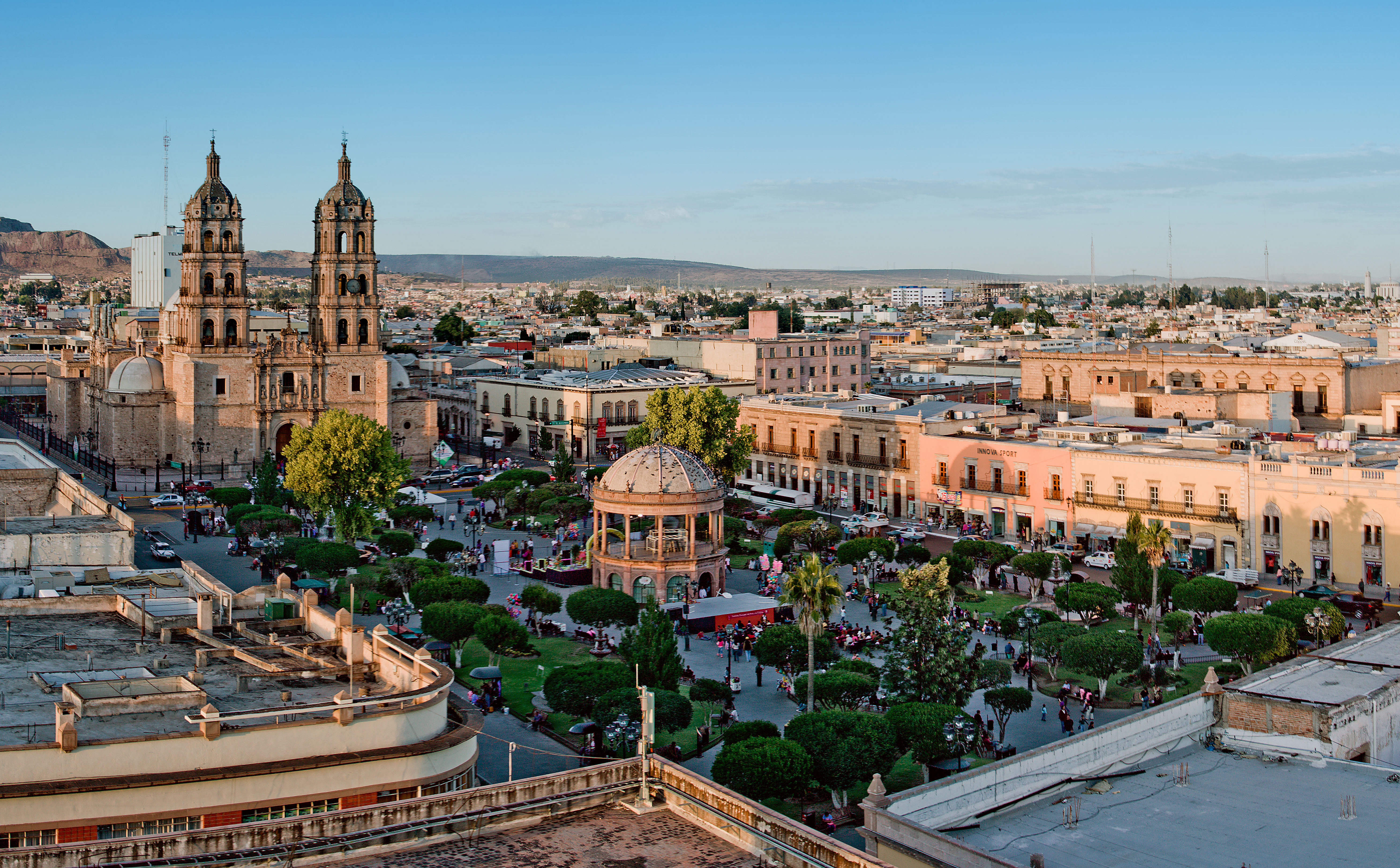

Beautiful downtown Durango

We spent most of our two days there wandering the streets and boulevards, gardens and plazas, watching the people around us living their lives. The time flew by and before we knew it we were back in the little Renault, once again, bombing down the Devil’s Spine. This time we stopped at the Park Natural Mexiquillo and hiked about 5 kilometers along a 16 kilometer unused railway bed, through forests of pine, unusual rock formations, breathtaking views and waterfalls.


Mexiquillo cabins

Hiking along a railway line that was never built

Waterfalls at the driest time of the year

View from waterfall - at the bottom of the picture is a drop off where the falls continue.  At the top of the picture you can just see a wire - it's a zip line for the more adventurous explorers!

It's not hard to feel you are on top of the world at about 7000 feet!

Unusual rock formations in a windswept plateau

If we had wanted, we could have rented a cabin on the site and explored it further. In fact, the mountains and the canyons in this area have several destination outdoor adventure areas where you can stay in cabins, or camp, hire guides with horses, go fishing in fresh water reservoirs, hiking, climbing – just about any activity we would do in the Canadian mountains – at a fraction of the cost. From the very, very little we have seen of Mexico so far, we can tell it is a very diverse and stunning place. I highly recommend a trip to Durango should you ever get the chance.

Sunday, January 30, 2011

Leaving Mazatlan

Today we leave Mazatlan.  Yesterday we celebrated our departure by taking the bus to Cerritos to have a seafood dinner on the beach before walking back to Ka'sala. 

Beach at Cerritos looking south to El Cid and the marina breakwater

View from the restaurant - we will pass these islands on our way south this afternoon

We enjoyed the slower pace in Mazatlan which allowed us to catch our breath, slow down, enjoy this beautiful city, visit with friends, and get some boatwork done.


I hoist Doug up the mast with the main halyard winch so he can lubricate the sail slots.

The last of the Cetol comes off the companionway doors and Schooner varnish goes on.

We were also fortunate to be in Mazatlan at the same time as family friends, Sid and Angie. They were staying at El Cid and on several occasions I was able to spend some time with them. They have been coming to Mazatlan annually for many years and did not waste any time showing us many of their favourite spots and introducing us to some of their favourite people. One night they treated us to an excellent Italian dinner. Thank you, Sid and Angie!


We've loved our time here and, although we are looking forward to continuing the adventure, we will surely miss this wonderful place.  I know we will be back someday.  Even after a month there is so much more to do and see, let alone enjoy the climate for rest and relaxation.

We are heading to Isla Isabel - an island made famous by Jacques Cousteau many years ago.  Known as Mexico's Galapagos, it is home to thousands of nesting birds - specifically frigates and boobies.  The anchorage is supposed to be rocky and a little exposed - people only go in calm conditions.  The weather looks like it might cooperate and I'm looking forward to some photo opportunities.

From there, the plan is to head toward San Blas and stay in the bay at Matanchen and, when conditions are right, enter the estuary to stay at the municipal docks in the town.  San Blas is a small Mexican town with some interesting things to see and do - primarily a panga trip through the estuaries, into the jungle to some freshwater springs and a crocodile preserve.  Unfortunately, San Blas is also famous for its noseeums.  Well - no pun intended - we'll see.  We have screens and bug dope, so hopefully we will survive.

The adventure continues.......

Saturday, January 29, 2011

Mazatlan - Part 4: Bambeleiro

One day in Mazatlan we looked up from the cockpit to see Carl and Cristina from Bambeleiro calling to us from the shore. They had sailed across the Sea of Cortez from Los Frailes in some very windy conditions, but had made it to the coast with no problem aboard their beautiful Ranger 33, which they had completely refitted. We were delighted to see them and immediately planned to do some things together. Initially they had anchored in the harbor, so we met them by the old Club Nautico and walked to the top of Isla Creston to see El Faro, one of the highest standing lighthouses in the world (515 feet).

View of Mazatlan harbour from the lighthouse - Stone Island anchorage in the background

Bambeleiro is just behind the ketch in the anchorage.  Note the 3 cruise ships in the background.  (Due to the recent shooting of one foreigner in Mazatlan, the cruise ships have since stopped coming here - imagine the economic impact of that!  Would cruise ships stop coming to Vancouver if one foreign tourist was shot?)

Carl and Cristina

Malecon in the background

El Farro

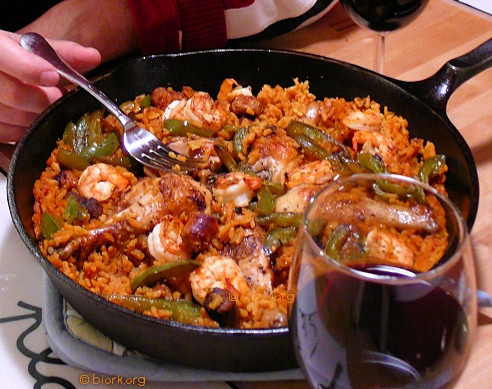
Later, Carl and Cristina moved Bambeleiro around to the Singlar dock beside Marina Mazatlan, so we were able to have dinner together on several occasions.  We even having another rousing hand of Escoba!  One night Cristina made us a  wonderful authentic “Catalan” paella chock full of shrimp and so rich and tasty it was impossible to even converse as we ate it.  It just melted in our mouths – along with our favourite Mexican red wine from the Baja. What a treat!


Although this isn't the exact dish Cristina prepared, it is similar.  Once again, I was so overwhelmed by the food, company and amibience, I forgot to take a picture.

Over dinner that night, I confessed my night watch strategy – dancing to Shakira in the cockpit. Cristina said: “You like Latin music?” I said: “Yes! You can’t sit still – it compels you have to dance – you have no choice!” A few days later, this intrepid and thoughtful cruising couple dropped off a CD absolutely PACKED with up tempo Latin music – enough to keep me dancing all the way to Hawaii! Yahoo!

Another evening, just at dusk, Carl and Cristina paddled to Ka'sala with a different type of present - a whole skip jack tuna!  This required some research and the watching of several how-to YouTube videos (http://vimeo.com/6907757 - to give you an idea), but after a great deal of discussion and preparation Doug was able to clean and filet this little treat into two dinners - one on the BBQ and another on my nifty cast iron grill.  Although it wasn't as succulent as the albacore we had enjoyed in Coos Bay, it was succulent. 


Skip Jack Tuna

After a week together, Bambeleiro departed for points further south.  Hopefully we will see Carl and Cristina again soon - I have a few dance moves to show them!  Thank you both!

Wednesday, January 26, 2011

Mazatlan - Part 3: New Taste Sensations

Mexico is a place of culinary delights and adventures. In my last entry I wrote about our fabulous mesquite grilled fish dinner at the beach side palapa along Mazatlan’s malecon.  Now I’d like to highlight some other wonderful food experiences.

Tamales

Tamales are the perfect food – tasty, healthy, covers all the food groups, visually appealing and eco friendly. When my “garden” man recommended them to me one morning I was buying bananas at his truck, I was eager to give them a try. He keeps them hot in a yellow cooler on the tailgate and offers: Chicken or Beef?

Note the scarf!  It is chilly early in the morning.

Wrapped in corn husks and tied neatly, they are cut open to reveal a stuffing of meat, tender/crisp vegetables such as carrots, jicama, potatoes, green and/or red pepper, surrounded with corn meal that has the consistency of polenta.


Beef Tamale

The whole packet is steamed and the end result is such a succulent, smoky morsel that you are already thinking of when you will have your next one. They leave you feeling comfortably full with lots of energy for the day. Doug loves hot sauce on his, though I love the subtle unspiced flavor.

Empenadas

I hate pumpkin and feel lukewarm about zucchini, but when my garden man suggested I try and empanada I didn’t hesitate. This tasty, turnover-type bun is filled with a sweetened squash paste that defies description. The bread surrounding it is neither sweet nor salty, but a perfect covering for the stuffing inside. We warm them in the oven, then eat them with the fresh fruit of the day – often cantaloupe, green grapes, and oranges, also recommended by my garden man.


Chiles Rellanos

I convinced Laura, from Chirpy, that the garden man was the best bet for ultra fresh produce. One morning she joined me at his truck and her eyes lit up when she saw the poblanos peppers.


“Have you ever had Chiles Rellanos?” she asked, with a twinkle in her eye.

I had to admit that I knew what they were, but had never indulged. I had always considered them too gross looking and probably very fattening. Boy, was I wrong!

Laura and Paul invited us over to Chirpy one night and she made this fantastic dish. It was as light as air, tasty, but not overly spicy, a light crust of whipped egg white on the outside, surrounding a crunchy mild pepper stuffed with queso fresco. She had created this gorgeous dish in a frying pan to the perfect temperature allowing all the textures to exhibit their finest qualities and have the cheese soft inside.

This is not the dish Laura served, but gives you an idea of what the finished product looks like.  I was so excited to eat her chiles I forgot to take a picture.

Alongside the chiles she served a piquant salsa that complimented the mildness of the dish. Of course, all of this was served up on the most colourful hand painted Mexican plates – a perfect compliment to the meal.

A sampling of colourful Mexican plates

Oh!  Did I forget the Roija?

Thank you, Paul and Laura, for such a memorable evening!

Churros

All around markets, on street corners, by the beach, you will find a little stand selling churros. For the longest time I couldn’t figure out what these strange looking things were. Long skinny pastry-like things, were they sweet or savoury?


Finally I got up my courage and bought a few from a street side vendor in Durango. He gave me a great toothless grin and popped an extra one in for the grand total of about 50 cents for 4. Delicious hardly describes them. They are, indeed, the Mexican doughnut, but not so sweet you feel like your teeth will melt (like one at Tim Horton’s), but just right. Later on that day we passed a little shop that had a churro machine and I could see how they were made. I don’t see a lot of churros in my future, but they sure are good for a treat!

Churro Street Vendor

Coffee

As soon as our eyes open in the morning Doug and I think: coffee! We like it dark and strong and smooth. Over the years we have developed a house blend that began with Vienna Blend from the Pot of Gold Roasting Company on Thetis Island.


www.potofgoldcoffee.com

When that became too expensive, we experimented until we found that mixing a bag of Costco’s Kirkland Brand Starbucks Expresso beans with their House Blend, we were able to create a reasonable facsimile of our Pot of Gold favourite. For this trip we stocked up in Canada and then again in San Diego. Now we are almost out, so began an exploration for a Mexican replacement.


Here in Mazatlan we were lucky to find The Looney Bean. (http://looneybeanmaz.jimdo.com)/   This little coffee company has the only coffee roaster we have found to date in our travels here and produces two dark bean products – a house blend we found rich, but slightly bitter and another smoother product called Chiapas.

Heavenly mornings!

We were so enamoured we tracked down the shop that has the roaster (in Cerritos) and bought 10 pounds that had just been roasted for a grand total of 850 pesos, or approximately $70.00.

Looney Bean Shop in Cerritos

When was the last time you paid $7.00 a pound for freshly roasted beans from a boutique coffee shop? We are more than relieved to know we will continue to enjoy our morning buzz!

Mazatlan Mercato

Most large towns we have been in have a mercato of some sort – a place for locals to sell their wares. These public markets have everything from soup to nuts, fish mongers and butchers have stalls side to side with candy sellers, clothing shops and food stands.

A different kind of candy store!

It’s always a colourful experience, though a little stressful as all the sellers are competing with each other for your pesos.

Colour and motion everywhere!

Architecturally, Mazatlan’s mercato is special. It was designed by the Eiffel brothers – the same guys who designed the famous tower in Paris – and you can see evidence of their art nouveau style throughout.


 Upstairs are more food stalls and one day we enjoyed a very inexpensive seafood lunch there with Carl and Cristina from Bambeleiro.

Carl and Cristina - note the cathedral spires in the background - the mercato is just a few blocks away from the historical district

Truly, we have delighted in all the new food we have encountered along the way and look forward to many more culinary adventures in wonderful Mexico.