Wednesday, April 27, 2016

Exploring the Sea of Cortez Part One - March 28 to April 1: Caleta Lobos to San Evaristo


Leaving La Paz and Caleta Lobos

After one last Zumba class, one last almond croissant, and the purchase of a few boat supplies from Lopez Marine, we lifted our anchor at La Paz in the early afternoon of Monday, March 28. 
Joanneke and Doug drinking IPA at Harkin SUP in La Paz

Last night in La Paz-- dancing in the street with Jan and Joanneke
 As it was later in the day we decided to only go as far as the Caleta Lobos anchorage, ten miles north of the city.  We stopped along the way to top up our fuel at Marina Costa Baja and oogled Steve Jobs’ incredible yacht which was moored there.  

Ka'sala at the bow of the late Steve Job's high tech yacht at Marina Costa Baja
Sailing with our friends Jan and Joanneke aboard Witte Raaf, we were expecting to drop anchor in Caleta Lobos on that hot afternoon for a swim and a relaxing evening with an early-to-bed.  Why is it nothing turns out as planned?  Within minutes of dropping the hook we were set upon by a cloud of bobos, the most obnoxious of flies, which look like black flies but don’t bite.  Instead, they flit into your eyes and ears, crawl along your hairline, tickle up your arms, and try to join you for dinner.  Ugh!  We put in ourscreens and cowered below, eating a simple supper.  Then the wind picked up.  Caleta Lobos is a great anchorage, except when winds come from the west.  Guess where they came from?  Straight in from the west.  From my journal I wrote:

Soon as the sun set a south westerly wind began and quickly increased, giving us 20+ knots of wind throughout the night.  The seas built and in a couple hours we were hobby horsing through close set white caps, driven across the Bay of La Paz and into the anchorage.  We had the AIS anchor watch on and we held fast on the lee shore.  It was so bumpy, I moved from my forward berth into one of the settees and rigged the lee cloth.  Both of us slept fitfully.  In the morning I was scared to leave and scared to stay but, in the end, common sense prevailed and we departed about 7am.  It was a bit tricky getting the anchor up, as we leaped up and down, but I got it up and tidied away without falling overboard or getting too wet.  Doug cranked up the engine rpm to motor against the wind and waves out of the bay and - we were free!

Caleta Lobos on a calm day - we were in the upper middle bay (picture from SV True North blog)
Our original plan had been to go from Caleta Lobos to Caleta Partida, an anchorage between Isla Espiritu Santos and Isla Partida to do some hiking.  From there we would continue on to Ensenada Grande and Isla Islotes to swim with the sea lions.  Unfortunately, these anchorages would also be exposed to the south westerly winds predicted to continue at night over the next few days.  Instead, we decided to move out of the Bay of La Paz, where these winds were the strongest, and head for San Evaristo, a small bay and fishing village on the Baja mainland 45 nautical miles north.  After our dramatic start to the day, we found ourselves motor sailing by the early afternoon and arrived in San Evaristo a few hours later. 

Beachfront - village of San Evaristo
Unfortunately, our dream of a calmer anchorage was not to be.   As I wrote in my journal at the time:

We have been getting to know our anchoring gear a lot better these last few nights as we find ourselves in more exposed areas.  At 8pm the wind comes up as if a switch has gone off.  It blows in from the west and accelerates down through the mountains - upwards of 30 knots.  Ka’sala dances back and forth on the chain and the wind generator howls.  Fortunately, in San Evaristo, there is no fetch and we are not on a lee shore.  It is a sobering thought, however, when you look out into the pitch black, star-studded sky and try to imagine dealing with a dragging anchor.  We never want to find out!

Ka'sala downwind on the way to San Evaristo (Joanneke photo)
San Evaristo

We stayed in San Evaristo for three days, waiting for the westerly winds to play themselves out. There was a steady flow of sailboats in and out and it felt like the bay was a transient spot for sailors moving up and down the coast.  The inside of the bay was lined with a white sand shell beach.

The road leading to San Evaristo
Set just behind the berm was a series of fish shacks and we watched with fascination as the pangueros went about their business.  They had several floats in the bay with huge blue barrels filled with what I think was bait.  We watched them transit back and forth between them, the beach and out to sea.  Behind the shacks was a tiny village with an even smaller church.  It’s illuminated cross is a beacon for the returning fishermen.  Behind the village, the steep, striated craigs and cliffs of the Gigante Mountains form a surreal backdrop.  Illuminated in sun and moonlight, their unusual colours and shadows give San Evaristo a moody vibe.  There is no electricity, but the hum of generators could be heard, especially from the desalination plant during the day.

Ka'sala and Witte Raaf in the San Evaristo anchorage looking east to  Islan San Jose
We also went for a hike along a dirt road leading to an area of salt pans and up into the hills beyond.  


Rough hiking through the cactus and prickly bush

Jan and Doug on the way to the salt pans

Looking at the salt pans from the hills
We had kayaked to the beach and, as we were dragging them ashore, we were joined by Bobby, a medium sized brindled dog who proceeded to accompany us for the rest of the day. 

Bobby loved having his ears scratched (Joanneke photo)

Bobby
We passed a couple of rancheros behind the salt pans and continued back to the village to visit Maggie Mae’s – a little restaurant on the beach.  She made us some of the best fish tacos I have ever had, accompanied by ice cold cervasa.

Ranchero - notice the solar panel (Joanneke photo)
Bobby lay panting beside us.  While waiting for our lunch, Joanneke and Doug painted our boats on enormous chocolata clam shells.  These small works of art would join many others decorating Maggie Mae’s patio.

We're looking forward to seeing this shell in the collection next year
We learned from her that there were about 50 families living in San Evaristo, but not at the same time.  Most of the children go to school in La Paz during the week accompanied by one parent and staying with family.  It takes three hours to get to La Paz on dirt back roads.  Although there is a small, local, primary school, there is no regular teacher.  Instead, student teachers come on a three month cycle to educate the 15 or so students in Grades 1 – 6.  Although most families get their groceries in La Paz, there is a fruit and veggie truck that comes to visit once a week and a buyer comes regularly to purchase the fish from the locals and those who live on the outer islands.  There are three “fancy” houses in town inhabited by “important” people such as the director of the fishermans’ collective.   San Evaristo seems a vibrant place, though I wonder if the children will return, full time, once their education is complete?

Imagine living in this San Evaristo landscape!  (Joanneke photo)

Thursday, April 14, 2016

Puerto Escondito

We are currently in Puerto Escondito in the Sea of Cortez after spending the last two weeks making our way up here from La Paz.  We haven't had any internet so I have not been able to post.  The internet here is unreliable, so I will just check in now and write the full monty later.  This area is truly spectacular and we have been super enjoying ourselves.  Travelling with our friends Jan and Joanneke, aboard Witte Raaf, has been a real treat as they are very familiar with many of the anchorages on the eastern side of the Baja and have been sharing their wealth of knowledge and experience with us.

We leave here tomorrow and, over the next two weeks, will make our way farther north, then cross the Sea to Guaymas to haul Ka'sala at Fonatur the first week in May.  We hope to by back in the Comox Valley by mid May.

In the meantime, here are a few photos to give you to whet your whistle!:

Anchorage at Aqua Verde

At Honeymoon Cove - Gigante Mountains and Puerto Escondito in the background

Beach at Los Gatos

Secret Beach near Aqua Verde

Lovely rock formations at Los Gatos

Friday, March 25, 2016

La Paz Redux

We have been a little over a week at anchor in La Paz, right beside the Marina de La Paz where we docked at Christmas.  Needless to say, it’s a lot less expensive!  The Marina is very kind to itinerant sailors and, for a small fee, allows us to tie our dinghies to their secure dock, gives us access to filtered drinking water and garbage disposal, as well as the showers.  There is a laundry on site and a small restaurant.  The anchorage itself is very pleasant.  Although there is a strong current running, and sometimes the boats out here dance around in wind versus current chop, for the most part we are very comfortable.  We enjoy long, lingering sunsets and lovely sunrises.  We are visited daily by dolphins and many species of marine birds soar above us.  Frequently, there is a breeze which flows through the port lights and hatches keeping us cool in the increasingly hot temperatures.  Sitting in the cockpit to enjoy our meals and watch the activity around us is very enjoyable.  The anchorage is very large, bisected by a channel that services this marine port.


Views of gorgeous La Paz from the sand bar at the other side of the estuary
We are anchored in front of two boatyards with yachts on their docks and in their hard stands.  Nearby is a fisherman’s beach and  pangas glide by regularly (well, some zoom), filled with tourists going to one of the outside beaches or heading out to swim with the whale sharks.  Farther along there is a small navy base and in the morning we can hear the call to muster.  The weather is sunny and warm with most days hitting 30 degrees.  Each day the water seems to be getting warmer and we have been in swimming several times.

Full Moon over Marina La Paz (taken from our cockpit)
As this week is “Semana Santa” (Week of Saints) there is a lot more activity than usual.  One night we saw a group of people carrying large musical instruments to the end of one of the boatyard docks.  A little while later two large boatloads of people docked and the music began and lasted, full blast until the wee hours.  I’m not talking serenade, either.  Tubas, trumpets, drums, guitar, singing at the top of the lungs amplified, makes for an interesting concert.  The music is in Spanish, of course, and I cannot explain what it sounds like, except to say it is very boisterous, energetic and polka like.  The other amazing thing is that the troubadours did not take a single break.....for hours!  These public concerts are not unusual in Mexico – you hear them everywhere – and loved by all - almost as if a celebration isn’t a celebration without one of these bands playing.  They are so loud I can hardly hear myself think, but others seem to be able to continue with their conversations and activities while the cacophony goes on.  For my part, although I do enjoy some of it, it can wear me down.  The only way I know to survive it is to learn to tune it out, well, how about “fade” it out!  LOL!

Although this is not the band we heard, it features the instruments we typically hear.
During Semana Santa the children are off school for two weeks.  This is also Easter and the Easter Bunny is nowhere to be seen.  Instead, most of this time is devoted to family, beach vacations and the celebration of the Passion of Christ.  During these weeks La Paz, and many other beach communities, are flooded with tourists from inland.  Entire families descend to enjoy the beginning of the long days of spring, the warming of the water and the heat of the sun.  At sunset, the malecon is full of strolling families, teenagers, lovers, and children - gringos are outnumbered tenfold.  The restaurants and cafes fill to overflowing with happy families and it is lovely to hear the laughter and see so many smiling faces.  The churches move into high gear with community processions re-enacting the 12 Stations of the Cross and various other proceedings marking the end of Lent and the events of the last few days of Jesus’ life and His rebirth.  I have been learning a lot about Mexican interpretation of Christian culture.
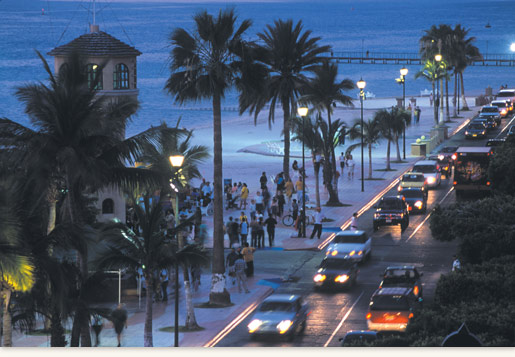
La Paz malecon at night
Both of us love La Paz and it didn’t take us long to get back into the swing of things we experienced when we were here in December.  I returned to Zumba with Joanneke and was delighted to see familiar faces.  Andrea, a.ka. the kid, kept us on our toes to work off those extra tacos.  I so enjoy the half hour walk to Zumba with Alison, Leanne and Ida, the ladies from the marina, and the meandering foraging with Joanneke on the way back, stopping along the way for coffee, a visit to the bakery, the mercado and Arambura (the cow shop).

Icon for our favourite bakery
Meanwhile, Doug has been busy on the boat trying to work out the mystery of the electrical wiring.  Everything is working, but not perfectly, and he is frustrated by the tiny spaces he has to try to get his hands into to feel around without seeing.  Many of these spaces are behind the panels at the navigation station, which are all beautifully, but individually, installed into the cherry wood.  If he just cut away the gorgeous wood he would have no problem, but then it would look ugly with wires all over the place.  Living in Ka’sala is like living in a piece of fine furniture and we both want to keep that aesthetic.  

Ka'sala's nav station - Port lights at top, monitor (which we use as a chart plotter) to the left, then 2 electrical panels.  Next row stereo, AIS, windlass switch, GPS, next row is SSB (shorwave radio) and radar, last row are two electrical monitors and the propane switch - all these instruments are framed by cherry wood
Doug has had more success with painting.  He has continued to hand paint the exterior gelcoat, this time on the starboard side.  Even though it takes him three days to complete a small area, the results are stunning.  Unfortunately he has run out of paint, so may not be able to continue with the other sections until we can acquire more. 

Beautiful mirror finish after meticulour brush work
On several evenings we have gone into La Paz for dinner.  It is hard to resist the malecon at sunset, so each one has begun with a relaxed stroll, followed by a cocktail in one of the several bars that line the opposite side of the malecon.  Doug and Jan have made good use of the SUP bar which serves IPA from the Baja Brewing Company in San Jose.  We’ve eaten in the garden at El Mesquite, which probably serves up the best grilled steak with all the trimmings I have ever had.  At other places we’ve enjoyed wood fired thin crust pizzas and delectable pastor tacos.  Eating out is very reasonable here and, because we are not paying marina fees, we have a little more money in the kitty to take advantage of it. 

Yummy pastor taco restaurant - the pastor is layered pork on the round in the middle - pinapple on the top.  The cook shaves the meat off, much like a swarma
On Monday, March 28, we are leaving with Witte Raaf to explore the coves and islands north of here on the eastern side of the Baja.  Jan and Joanneke have been up and down the coast several times over the last two winters and will be our guides to their favourite anchorages. 

Witte Raaf at anchor beside Ka'sala at La Paz
We anticipate swimming and snorkelling with marine life, hiking in the exceptional terrain, watching more incredible sunrise and sunsets, great meals with friends, discovering new anchorages in remote locations, and meeting new people. We feel very fortunate to be travelling with J & J, not only because they are familiar with the area, but also because we will have quality time to spend with such good friends.  While we are sailing in this remote region we will have limited, if any, access to WiFi and cell coverage so we may be out of touch for a few weeks.  Imagine.  No Internet!  Whatever shall we do?

We may make it as far north as Santa Rosalia before crossing to the mainland again
Our time in Mexico is soon drawing to a close as we plan to be in Guaymas, on mainland Mexico, the first week in May.  We will be storing Ka’sala on the hardstand at the Mexican government owned Fonatur marina there for the summer but, before we leave her, we will need to do a lot of preparation.  Although this area is considered hurricane safe, it does get extremely hot in the summer with temperatures averaging in the mid 30’s.  Temperature chart for Guaymas:

Annual

Average Max Temperature °C ( °F)
23 (73.4)
24 (75.2)
27 (80.6)
29 (84.2)
33 (91.4)
34 (93.2)
36 (96.8)
35 (95)
35 (95)
33 (91.4)
28 (82.4)
24 (75.2)
30.1 (86.2)

Average Temperature °C ( °F)
18 (64.4)
19 (66.2)
21.5 (70.7)
23.5 (74.3)
27 (80.6)
29.5 (85.1)
32 (89.6)
31 (87.8)
31 (87.8)
28 (82.4)
23 (73.4)
19.5 (67.1)
25.3 (77.5)

Average Min Temperature °C ( °F)
13 (55.4)
14 (57.2)
16 (60.8)
18 (64.4)
21 (69.8)
25 (77)
28 (82.4)
27 (80.6)
27 (80.6)
23 (73.4)
18 (64.4)
15 (59)
20.4 (68.8)


We will need to remove all the sails, halyards, and canvas, as well as any moveable part above deck, and store them below.  Then we will need to set up our boat cover and secure it on to help protect the decks from sun and dirt.  As the boat will be shut up below, we have to prepare for extreme heat.  The port lights and hatches will all need to be covered with aluminum foil and all orifices plugged to inhibit water and insect penetration.  We will need to vet and dispose of stores, and organize the space below to accommodate the things from above.  We will be leaving Ka’sala with only our backpacks and a couple duffel bags, so all our possessions will need to be sorted out.  I can only begin to imagine what all needs to be done.  Experienced cruisers tell us the preparation can take up to a week and all of it done in the extreme heat.  Best we enjoy these next few weeks of R & R!

Full Moon sunrise at La Paz

Friday, March 18, 2016

Mazatlan Redux

We have been fortunate to spend another week in Mazatlan.  Well, that was no hardship, believe me!  What an incredible place!

Last night in Barra de Navidad, celebrating Doug's birthday complements of Mom (Thank you, Mom!)
We left Barra de Navidad, as planned, right after breakfast on Saturday, March 5 and spent 56 hours making our way to Mazatlan.  Conditions varied from no wind, to moderate northwest winds which we were able to comfortably beat through, to brisk south east winds we flew through.

Wing on Wing
The seas were also variable – from flat calm, to confused, to a 4 foot wind chop accentuated by a continuous low southwest swell.  For the most part we were comfortable and Ka’sala managed without difficulty. 

Typical sailing on the Mexican Riviera

Unfortunately we saw very little wildlife and were far enough off shore that we did not see much of the landscape as well.  However, the no-moon, star-lit nights were magnificent to behold.  Our trusty Yanmar accompanied us for 2/3rds of the way and, by the time we had reached our destination, we were very happy to not have to listen to the pounding of its pistons anymore.   

What made this journey interesting was how it ended.  Our last few hours we were bouncing along in 20 knots and a four foot chop.  The tide was at its lowest point and we had to navigate the narrow opening of the bar into the Mazatlan marina lagoon.  As we approached, we saw the waves heaping up on both sides of the breakwater, but in between, there was a clearly visible slot.  Doug slipped Ka’sala through this crack and within seconds we were in the calm waters of the lagoon.  It wasn’t until later that we found out the entrance had been closed by the harbour authorities.  Gulp!

We headed straight for the Pemex fuel dock to take on more diesel, but not before we skidded along the bottom as we approached its dock in the negative tide.  Luckily we did no damage.

Mexican charts aren't all that great.  As you can see it shows Ka'sala well on shore - we didn't go that hard aground!
We were incredibly pleased to discover our friends Lindy and Al from Enchante had arrived in Mazatlan the day before from Matanchen Bay.  They were docked at Fonatur and we tried to join them there, but it was full.  We moved over to a smaller marina resort in the lagoon where we were happily ensconced for a little over week.  Lindy and Al joined us there for a few days at the end of our stay. 

Can you see Ka'sala?  (centre back)
Pool at marina resort
We were pleased to get the bicycles on the road and ride the malecon again.  In addition to recreation, we were able to use them for provisioning and other errands.  The laundry lady got quite a kick out of me arriving with my large parachute bag stuffed full of clothes and bungied to the rack on the back of the bicycle.  We also had the chance to walk along the magnificent beach to Cerritos and enjoy ice cold  cervesas at a palapa at the end, running our toes through the hot sand. 

He flies through the air with the greatest of ease......cleaning the rigging!
On one day, Al, Lindy, Doug and I caught a local bus to visit the town of Concordia.  For about 80 pesos return each ($6 USD) we travelled about 35 miles along an assortment of roads, watching locals getting on and off, noting their clothes, their way of speaking, their family groupings and imagining what their lives might be like. 


 We passed the many villages and towns where they lived.  Every place was a hive of activity with all sorts of things going on.  At every intersection it seemed someone was out there to entertain or provide a small service for a few pesos - from jugglers to gymnasts, from windshield washers to flower sellers, the roads were alive with people.

Our bus to Concordia
We wandered around Concordia, previously named San Sebastian, a place that has seen regular human habitation since long before the conquistadors.  It was a spotless town.  We did not see litter anywhere.  The houses were all painted in a variety of sandy hues and it was obvious that the townspeople took enormous pride in their hometown.


Concordia street scenes
We visited their renovated, very old church in the town square and, above the altar, its gruesome statue of the patron saint and martyr San Sebastian, pierced with arrows.

Facade of Iglacia San Sabastian
San Sebastian
We wandered down side streets searching for the furniture makers Al was looking for.  However, first we found the town museum and were warmly welcomed by Vicki, its curator.  She regaled us with stories of the town, especially the French occupation in the mid 18th century.  Vicki was very passionate about her subject and it was amusing to note the more enthusiastic she became, the less English she spoke, but we understood her.  The museum was in the old jailhouse and we could see the bones of the cells as we passed through the various well crafted displays, photographs and artifacts dating back hundreds of years.  Al eventually found several furniture makers and we were especially taken with a multi-generational Mexican family who were enjoying their Sunday family feast while the various pieces of their wooden rocking chairs dried in the sun.  We had a lovely lunch in what was likely the best restaurant in town, El Granero, tucked away near the old monastery.


 It consisted of several well appointed rooms and a large central courtyard that had been decked out for a wedding.  The lunch was in mammoth portions which began with complimentary local panela cheese, refried beans, salsa and tostadas.  Afterwards we waddled out into the hot, empty streets, as the sensible locals were digesting their comida in siesta!

In the town square is an enormous rocking chair - an icon of Concordia's most famous product and obviously a great photo opportunity for the tourists.  Perhaps in this sequence of photos you can figure out what I am trying to convince Lindy to do!  What a lot of fun!


Our time in Mazatlan was quickly over and we found ourselves looking for the weather window that would take us across the Sea of Cortez and back to the Baja.  We slipped through the bar at El Cid at 7am on Tuesday, March 15 to begin our 48 hour passage to La Paz, arriving on Saint Patrick's Day.