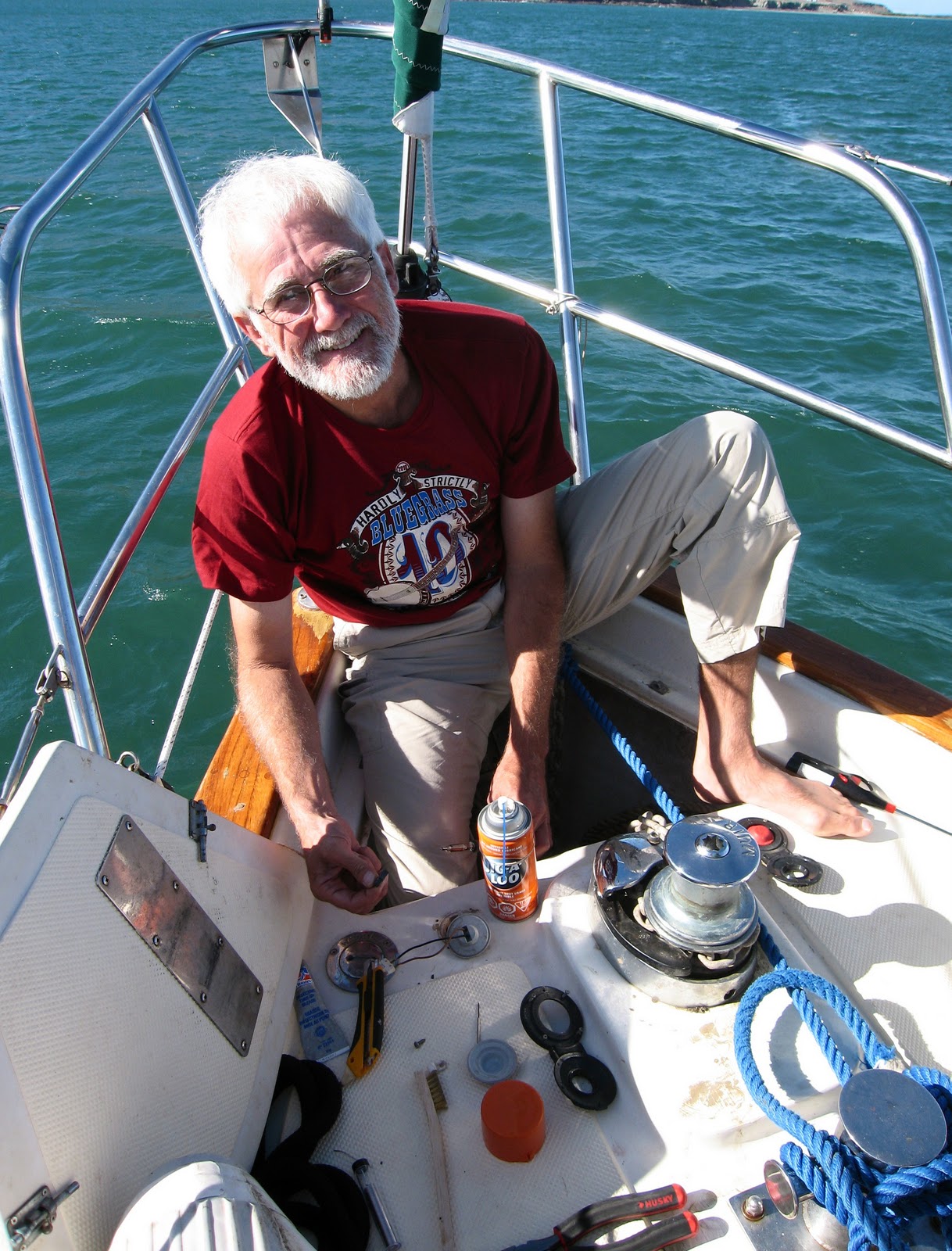
We woke up in the late morning and decided to spend the day on the boat doing some chores. When we had anchored, and we were relaxing with our beers, the windlass began to deploy chain on its own. Doug discovered the circuit had given way and disabled it. He spent the afternoon replacing the up and down switches. We were very grateful that Peter,
Ka’sala’s former owner, had the foresight to stock the replacements and Doug, with his excellent memory, recalled he had them on board and where he had stored them. (This sounds pretty simple, but you would be amazed what you can lose on a 34 foot sailboat. Currently, we are looking for a case of beer – no kidding!) Pulling up 50 meters of chain on the winch is not much fun and having the potentially dangerous windlass in top shape is imperative.
fixing the windlass switches
While Doug worked at the windlass, I cleaned and tidied the boat, as well as hand washing our passage gear. Even though we were approaching the Tropic of Cancer, it was still bloody cold at sea, and both of us were still wearing our long underwear and wet weather gear – especially at night. I would have loved to have cleaned more of our clothes – even if I had to do it by hand – for it had been over two weeks since we had seen a washing machine. Unfortunately, there is no fresh water anywhere to be had, so we were in full water conservation – even washing dishes in salt water. Spending our precious water to wash our passage gotch is indicative of how crusty we were! We also spent some on ourselves by taking quick washcloth showers, letting the water flow only to wash off the 2 in 1 shampoo/conditioner in our hair. We allowed ourselves these quick refreshing rinses in the small head, every three to four days after leaving San Diego.
Ka'sala at anchor in Bahai Santa Maria
another view of Ka'sala at the remote anchorage- (Photo: Steve Millar)
Later that day, we were glad to see
Silas Crosby arrive after a long 4 day passage from Isla San Geronimo. Close on their heels came
Le Bateux de Voille. In the morning we all raised our anchors and moved closer to the shore to get away from a strong NW wind that started blowing through the bay. We were seeing gusts over 20 knots, with wind waves swishing against the hull. Closer to shore the holding was still good, but we could find some relief tucked in behind the hills and when we went to shore in the dinghies, the distance would be smaller and less wet. Over the course of the next couple days we were joined by
Blue Rodeo,
Taking Flight and
Grace, as well as several power boats and another couple sailboats – quite a difference from when we arrived!
busy anchorage, but nothing like the Baja Ha Ha a month ago with 180 sail boats!!
On the second day we joined Steve and Meredith for a climb on the steep hills of Punta Hughes. Bahai Santa Maria is huge – a scallop on the outside of the larger Bahai de Magdelena which is purportedly the size of San Francisco Bay. Maria is framed by Isla Magdelena to the north and Isla Marguerita to the south. All along its back shore is a wide wind-swept berm of sand which divides the two bays.

aerial image of Bahai Magdelena - Bahai Santa Maria is the outer bay at the top right - dunes on the extreme right, Punta Hughes to the right of the entrance to Santa Maria with anchorage just inside
In the curve, at the north end of Santa Maria, where we were anchored, to one side are the steep hills and, ahead of us. the narrow, shifting opening to a mangrove lagoon. Within the mangroves lie two tiny fishing villages and a fish camp.
mangrove lagoon
Farther along is a dirt 4X4 trail that leads to a massive Sahara-like dune area and the largest, surf –crashing, wreck strewn, dead whale/tortoise beach, scavenged by vultures and coyotes, that I have ever seen.
dunes stretch out in the distance
the outside beach
But first, the hills. We came ashore on a small sandy beach and hauled the dinghies up onto the polished rocks. We donned our hiking shoes and headed up the arroyo and gradually found our way, first by following a path, then by scrambling up shale and rocks, to one of the higher peaks.
dinghies on the beach - Silas Crosby's remarkable folding dinghy in front
Throughout the walk we were accompanied by the smell of oranges. Oranges? How could that be? Well, not quite oranges, maybe ones beginning to mold? No trees, that’s for sure. There were only a few slight, dried up low bushes along the way, but when we looked closely and followed our noses, we found the tiniest yellow flower giving off the powerful scent. Surely this was something a perfumer could use as once we had it on our fingers and in our noses it took a long time to dissipate. The views from the top were spectacular. We could see far out to sea, both bays, the dunes, mangrove lagoon, glimpses of the far beach, and San Carlos in the very far distance. I felt very, very far from home and a tiny wet speck in a dry, bleached landscape. My camera could not capture the images I felt I could share.
Hills of Punta Hughes
The following photographs were taken by Steve Millar and given to me to use in place of my missing pictures. They really capture our walk that day! Thank you, Steve!
Walking through the arroyo (SM)
A long way up (SM)
At the top - entrance to Bahai Santa Maria in the background (SM)
Doug heads out into the Pacific! (SM)
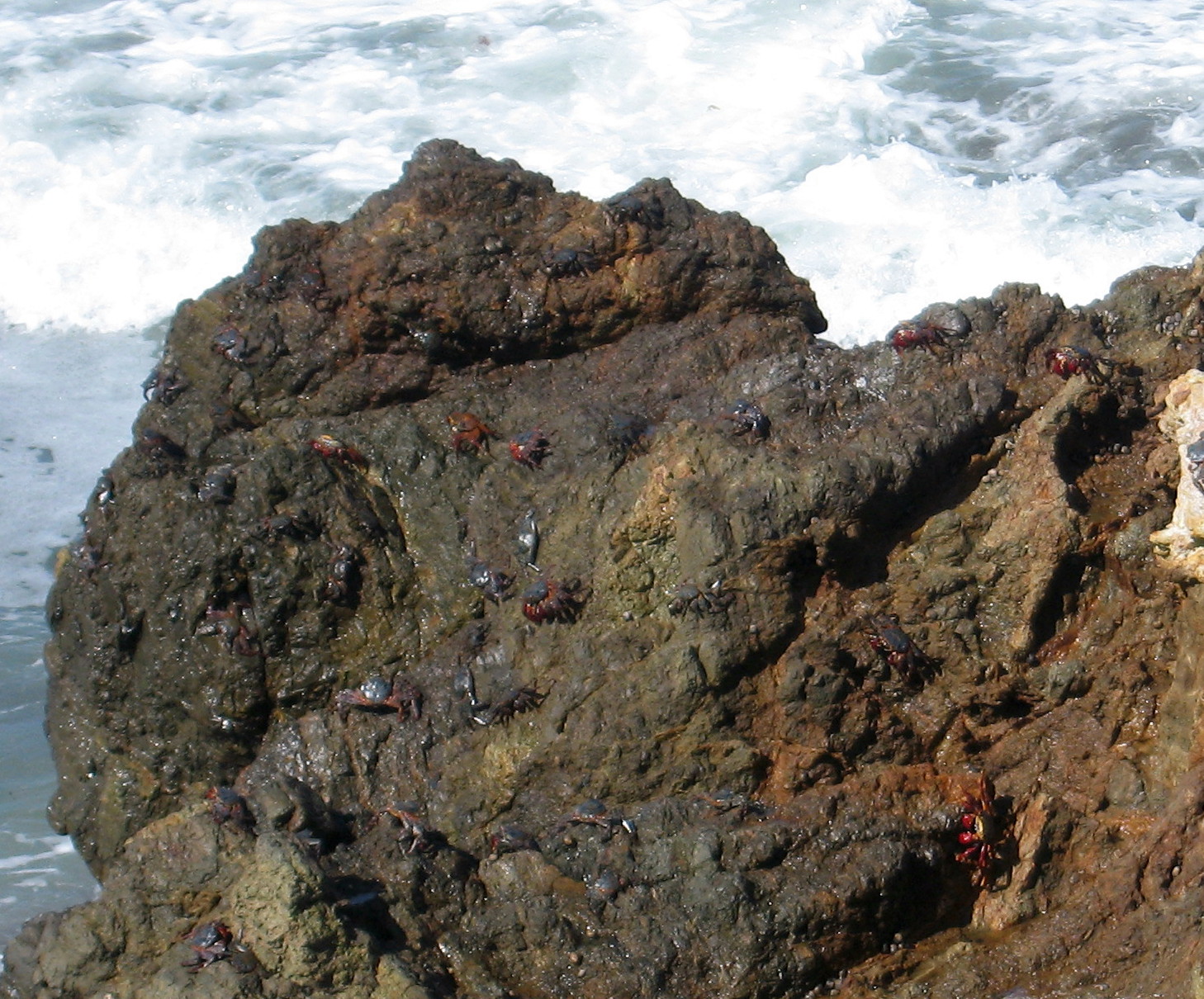
We scrambled back down and spent the last part of our walk picking through the tidepools on our way back to the dinghies. These were more confined spaces and tiny little microcosms I could understand. The pelicans stood guard all around and I was able to get quite close to them. There were no mussels on the rocks, but they were covered with limpets and very red, very fast spider-like crabs the size of my fist. I snapped many pictures that, unfortunately, will never be seen, for the next day my camera was lost.
crabs!
That evening the crew of
Silas Crosby joined us onboard
Ka’sala for the last of our meat. I had bought a large flank steak from Trader Joes in San Diego that had frozen in my icebox while marinating in teriyaki. Done up perfectly on the barbeque and accompanied by roast spuds and coleslaw it was, in a word, delicious. John brought a very nice bottle of Australian Shiraz and, for a while, we felt like we were in paradise.
Next day I curled up with Meredith’s 2006 version of
The Joy of Cooking, copied a few recipes, and tried a few out. Stupidly, I had left behind my “Joy” because I thought I could remember most of the ones I used regularly and could look up on the internet the ones I had forgotten. Whatever made me think the internet would be available in the places we found ourselves? Do we get so reliant on certain technologies that we just take for granted they will be available to us at our every whim? I felt kind of silly about it as I know better.

At any rate, while I made 2 loaves of whole wheat bread and a double batch of oatmeal raisin cookies, Steve, Meredith and Doug went kayaking at the mangrove lagoon. Doug had inflated the double kayak Steve had lent us, which we had last used, such a long time ago on Jedediah Island in the Georgia Straits. He took my waterproof Panasonic camera to get some great shots of the birds and surf he knew he would find there. Because I wasn’t going, he also wanted to be able to share his day with me and contribute to the blog. Unfortunately, on his way in on afast surf, the camera disappeared into the waves, got caught in the current and disappeared into the depths. Oh! The three of them looked for hours, hoping to find it, but to no avail. Thank goodness we still have the Canon!
Kayaking over to Silas Crosby
Earlier that day a panga had come along side. We had been watching them rush back and forth along the waterline between their traps and villages. The fisherman had lobsters to sell and wanted American dollars and “agua”. We bartered and got 5 lobsters for $9US and three cans of ginger ale. These friendly men were extremely curious about our boat and, as the negotiations went on, they craned their necks to look through the portholes. Once the men had left, Doug quickly dispatched the twitching beasts and, later that evening, we brought them over to Silas Crosby. Steve barbequed them and Meredith made up a big pot of rice and cold slaw. Oh – and some really terrific chocolate cake! Yes! Cake! Luxury!
For all of us, the provisions were starting to get a little sparse, so we were challenged by our ingredients to make interesting and tasty dinners. Did you know condensed milk, some old cheese, a quarter of an onion, and a rubbery tomato combined with Bisquick and eggs, makes a pretty good quiche? Did you know Stag’s chili mixed with rice and cheese tastes pretty good in a tortilla? Did you know a tin of peaches can taste like nirvana? You get the picture!
On the fourth day Steve, Meredith, Doug and I headed over to the huge beach on the other side of the lagoon. We had read that a sailboat in the Baja Ha Ha had gone ashore there the month before and thought we might like to see it. Also, John had walked it the day before and had all sorts of tales of what he had seen so we had to see for ourselves. I had no idea that the walk would take us most of the day and I was pretty sore by the time we returned back to the boat, but I wouldn’t have missed it for the world.
shoeing up for the big hike
We parked the dinghy on the beach and scrambled through the shale until we reached the tricky entrance to the lagoon. I was amazed to see the pangas roar through the narrow opening without any heed for the shallow and shifting depths.
pangas entering the lagoon
We skirted the two villages on the bluff behind – me clutching 6 polished stones in case we were chased by dogs – and continued along the dusty track. We saw large rabbits, dead and live coyotes, cactus, a shrine and little else. It was hot and dusty and eventually opened up to a vista of the dunes and beach in the distance.
a prickly landscape
roadside shrine
The first thing we came across on the other side was the remains of a wreck – looked like it had once been some kind of freighter.
wrecked freighter
We walked down the massive beach with 8 to 10 lines of breakers rolling in, vultures swirling over our heads.
big beach

As we walked along we encountered 3 dead whales washed up on the shore in various stages of decay.
dead whale
These had been huge beasts, so you can imagine that walking downwind from them was like! We noticed the coyotes watching us up in the dunes and, when we looked back, they had dashed back down on the beach to eat more of the dead whales.
coyote having lunch - lighthouse in the distance
There were also numerous piles of bones of sea lions, turtles and other beasts.
bone hunter
vultures waiting for the tide to go out
Whale "hair" (can't remember the name) found on the inside of their mouths, used to comb through krill (Photo: SM)
whale upper jaw, vultures waiting in the distance
We also saw two more wrecks of boats. All the time the waves roared as they charged into the surf, the spume flying. It was definitely a death-on-the-beach kind of place and not one you would go to for a peaceful, contemplative stroll.
Sailboat wreck from November 2010 Baja Ha Ha - the captain, who was single-handing fell asleep and the autohelm brought the boat into the beach. How terrifying is that? (Photo: SM)
Death on the beach
It was a long walk back, but the tide was out, so we were able to pick our way along the shoreline, through a gentler beach and tidepools. This time we passed through the villages and Meredith talked to a few of the women who lived there. She discovered that they live part of the year in an inland town, but prefer their time at the bay when their men fish.
baby fisherman - all the pangas were called Isabel - just the numbers changed
These lagoon villages were very primitive, basically untidy shacks on little beaches with no running water or electricity. The boats, however, were pristine, with giant motors. Interestingly, we didn’t see any fish while we were there, but there was evidence of traps in the water off the beach, so perhaps they were there.
Pelicans wait by the traps
But they kept burros?
one of three we encountered on the track
At the last little collection of shacks we saw a large area of vertical drying racks, and horizontal ones covered with shark fins The fishermen were bringing in their day’s catch and we were amazed at the number of sharks they were pulling out of their boats and lining up on the beach. There were several different kinds – all 6 to 8 feet long – their teeth glinting in the sun. I could not understand how and where they could catch so many of them and, when Meredith tried to engage them in conversation, they weren’t particularly responsive. Were there no limits on the number they could catch? At the end of the day I was happy to return to the familiarity and comfort of
Ka’sala.
More death on the beach (Photo: SM)
The next day the plan was to sail the 18 miles or so out of Bahai Santa Maria and around the corner into Bahai Magdelena. There are a number of anchorages inside the larger bay, as well as the town of San Carlos. Steve had been there on a previous cruise and was hankering after a repeat of a wonderful lunch he had there then. We also wanted to do some minor provisioning. Unfortunately, the wind was quite strong that morning and, although it was fine to sail out of the Santa Maria, when it came to turning in to the larger bay it meant we would have to beat into 20 to 25 knots of wind. Doug felt that was too much and we decided, instead, to continue on the 150 miles downwind to Cabo San Lucas.
Silas Crosby continued on into the bay along with three of the other sailboats. I was sorry to see them go.
Silas Crosby reefed in 25 knots