Whales
I heard the whale before I saw it. Actually, I didn’t see the whale, what I saw was the spume of its exhalation and the mist of spray which lingered before falling back into the water some hundreds of yards away. Then I heard it again, the unmistakable wheeze of a massive exhalation. This time I caught a glimpse of a tail flash and pause before sliding back into the water. Lyneita would want to see this.
We were sailing with the companionway hatch closed and drop boards in place. Not that it was really rough, but the odd wave was breaking against the side of the boat and it would spoil our day if a part of the ocean found its way into the cabin. Rule number one for cruising: (thanks Brad!) keep ALL the water on the outside.
So, I heaved forward on the heavy companionway hatch and leaned inside to see if I could get Lyneita’s attention. I didn’t have to look far because she was right there in the galley, on the port side almost under the companionway, making sandwiches for our lunch. I stopped and watched for a second admiring her ability to work in such a cramped space while the boat rolled and pitched. She had braced her back against the galley counter on one side, her two feet were spread as wide as her legs would allow, braced against the galley on one side and, clear across to the base of the navigation desk on the other. Meanwhile, she juggled a knife, slices of ham, and a couple of jars which slide back and forth on the counter top. Think: Subway meets Cirque du Soliel and you get the idea.
“Thar she blows!” I mock bellowed into the cabin.
“Whar away?” She responded putting down the mustard-loaded knife and turning to start up the ladder to the cockpit.
“Eight points off the port bow!”
Lyneita popped up through the companionway and looked to her left… to the Starboard side.
“Other side matey,” I offered helpfully. She looked the other way momentarily and then looked back to starboard.
“The ones on the other side are closer” she said in that patient tone I know so well.
And they were. Off to the right, starboard, was a pod of whales as close as I would ever want to see them, going in the opposite direction to us. The wheezing of their exhalations was quite loud now and we could clearly see their massive shapes as they surfaced and dove one by one and in pairs. They were wonderfully graceful as they seemed to pause slightly before they arched their tails high in the air and dove down into the ocean again after taking each breath. One very small tail emerged almost touching another bigger one: a calf with its mother no doubt. There seemed to be about a dozen of them lumbering their way North and we were sailing noiselessly more or less right down the middle of the bunch in the opposite direction. I was concerned that we might hit one, but they seemed to spread out to pass around us and then merge together again behind as we sailed by.
And then, the most amazing thing happened: a real monster (any creature bigger than the boat I am in qualifies for monster status in my estimation) surfaced a scant few meters away on the starboard side. Before taking its breath and diving again, this whale rolled ever so slightly and stared at me with its great eye. We made contact in this manner for only a second, but I was overwhelmed with the impression of intelligence in that brief exchange. This was no blank stare but a knowing glance. A connection between species which was enigmatic and knowing at the same time. Part greeting, possibly a warning, and then it was over. After the head submerged the huge tail seemed to hung in mid air for a longer than any of the others before disappearing…. a farewell wave…? Who knows? I don’t want to anthropomorphize the encounter and imply something which may not have been there, but… I have looked at and been looked back at by any number of animals and birds in my life and this was different.
Lyneita had witnessed this as well and we both watched mutely for some time after the last of the pod disappeared in the distance behind us. Finally, when it was apparent the last of them had gone she broke the silence.
“Do you want cheese with your ham sandwich?”
“Yes please.”

Monday, September 13, 2010

Charleston, Oregon: August 19 to 24
We stayed at Charleston Marina for five days. It didn’t rain, but most days began with fog which later burned off. It was chilly and some nights we had the heater on. Some days the wind howled and we could hear the breakers crash in the distance and other days it was calm in the morning and breezy in the afternoon. We enjoyed staying at the marina. The staff there was very helpful and friendly and the fishermen, who were busy with a terrific albacore tuna catch, were accommodating. If you want to find out more, here is the url: www.charlestonmarina.com.
 Local colour
 A Gathering Place for Feminine Mariners?
The first day we caught up on our sleep and worked on the boat. I painted the side decks to match the carriage roof and Doug changed the engine oil. The second day we decided to go for a hike and walked through the Oregon University campus of the Oregon Institute of Marine Biology, up a steep windy gravel road to view the Bar from the Coast Guard lookout station.
 Doug at the Coast Guard Lookout
 Coos Bay Bar
 Barge Crossing the Coos Bay Bar
We continued on to Bastendorff Beach Park where we had a picnic lunch and watched the rollers come in.
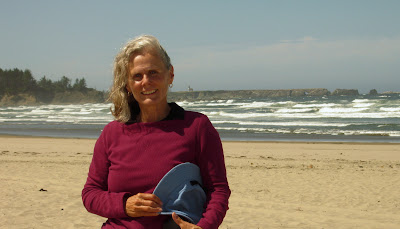 Bastendorff Beach, Oregon (lighthouse in background)
We enjoyed stretching our legs and enjoying this off-the-beaten-track countryside. We would have gone farther, as there was a lot more to see at the end of the Cape Arago Highway, including a state park, the lighthouse, adventure trails and spectacular scenery.
 Cape Arago
From my diary: Day before yesterday we went for a long walk around the point to an absolutely gorgeous out-of-the-way beach. It was quite a windy day, with the ocean rollers crashing in and people surfing. The flora is an interesting mix of what we are used to on Vancouver Island, like Oregon grape and salal, mixed in with what you would see in Northern California, like sage.
I’ve been reading about the history of this area and, like any place else on the coast, it was central for a large, thriving native population. Unfortunately they were pretty much decimated by smallpox when the white settlers started showing up. The whites weren’t particularly nice to them at all and quickly exploited the area for lumber, fishing, agriculture and other industry, ignoring the rights of the Indians. That was about 1853. Although the place has evolved over time, it really hasn’t changed much. According to the census data it has a homogeneous population, with few people of a different colour or culture. Only .2% of the population is native. I am amazed by just how many small fishing boats are still operating here – ones that have obviously been in families for generations.
Next day we headed into the village of Charleston to visit Englund Marine. While Doug was shopping for boat bits, I browsed in the Charleytown Market Place. I must admit, on first look I thought this might be a tickytacky tourist gift shop, but I learned, once again, never to judge a book by its cover. It was a charming place full of the most amazing assortment of local crafts and artwork, antiques, gifts, local preserves, wine and candy, jewelry, fibre arts and greeting cards. Doug had to come rescue me and, even then, I had found birthday presents for three of my family and a selection of writing cards for myself. Doug chose some Oregon cherry and wild blackberry jam. If we weren’t on a sailboat, I would have bought a lot more. It was a fascinating place to browse and the lady who owns it was a wealth of information. (http://www.charleytownmarketplace.com)

Funky cottage at CharleyMarket
 Works for me!
Unfortunately, Charleston does not have a grocery store, so the next day we made a trip into Coos Bay, the larger centre, to forage for provisions. This turned out to be interesting as well. For under 5 dollars, Doug and I rode a small bus all through the Coos Bay area. This inexpensive tour took us through many neighbourhoods and we got the chance to see how people lived in this area. Many of the houses we passed were small and neat – not a monster house in sight. Coos Bay is a working town.
Another day we went to the annual Seafood Festival, a modest celebration of life by the sea. We enjoyed some tuna tacos, barbequed Coos Bay oysters and some slow smoked ribs. Later in the day we bought a couple crabs at the end of the dock from a fishmonger and had them cook them up for us. Mmmmmm. Doug wanted French bread with his crab (of course), but there were no bakeries nearby. Instead, I made some bannock which also turned out well. I regret I didn’t bring a lot more of our Canadian flour. I remember just how special it is from importing it to make bread in Hong Kong. I can see myself baking a lot of quickbreads in our future as they are good and easy to make. My gimbaled Force 10 propane range and oven is a miracle and we depend on it to make our lives more comfortable. Doug bought a loin of albacore tuna for 14 dollars – we got about 10 small steaks out of it – and it looks absolutely amazing. I’ve been looking up recipes on the Internet and tonight we will have some of the steaks marinated in teriyaki on the barbeque. Of course, all this wonderful food goes extremely well with Alaskan Amber, another American favourite.
 Ka'sala's Galley
+of+alaskan-amber%5B1%5D.jpg)
The only other cruiser we met was another Canadian couple, Anita and Jay, aboard Karina C, a Spencer 35. They are gunkholing their way down to Mexico. Jay lent Doug his oil extractor, so I made an orange loaf from my Muffins and More cookbook and shared it with them. They also have a blog and you can follow their adventures at: http://www.sailblogs.com/member/jabigland.
 Karina C
At the end of the five days we were raring to go again and the forecast looked good. We cast off about 8am and headed out to sea with the hope that we would make it all the way to San Francisco. It was not to be.
 Local colour
 A Gathering Place for Feminine Mariners?
The first day we caught up on our sleep and worked on the boat. I painted the side decks to match the carriage roof and Doug changed the engine oil. The second day we decided to go for a hike and walked through the Oregon University campus of the Oregon Institute of Marine Biology, up a steep windy gravel road to view the Bar from the Coast Guard lookout station.
 Doug at the Coast Guard Lookout
 Coos Bay Bar
 Barge Crossing the Coos Bay Bar
We continued on to Bastendorff Beach Park where we had a picnic lunch and watched the rollers come in.
 Bastendorff Beach, Oregon (lighthouse in background)
We enjoyed stretching our legs and enjoying this off-the-beaten-track countryside. We would have gone farther, as there was a lot more to see at the end of the Cape Arago Highway, including a state park, the lighthouse, adventure trails and spectacular scenery.
 Cape Arago
From my diary: Day before yesterday we went for a long walk around the point to an absolutely gorgeous out-of-the-way beach. It was quite a windy day, with the ocean rollers crashing in and people surfing. The flora is an interesting mix of what we are used to on Vancouver Island, like Oregon grape and salal, mixed in with what you would see in Northern California, like sage.
I’ve been reading about the history of this area and, like any place else on the coast, it was central for a large, thriving native population. Unfortunately they were pretty much decimated by smallpox when the white settlers started showing up. The whites weren’t particularly nice to them at all and quickly exploited the area for lumber, fishing, agriculture and other industry, ignoring the rights of the Indians. That was about 1853. Although the place has evolved over time, it really hasn’t changed much. According to the census data it has a homogeneous population, with few people of a different colour or culture. Only .2% of the population is native. I am amazed by just how many small fishing boats are still operating here – ones that have obviously been in families for generations.
Next day we headed into the village of Charleston to visit Englund Marine. While Doug was shopping for boat bits, I browsed in the Charleytown Market Place. I must admit, on first look I thought this might be a tickytacky tourist gift shop, but I learned, once again, never to judge a book by its cover. It was a charming place full of the most amazing assortment of local crafts and artwork, antiques, gifts, local preserves, wine and candy, jewelry, fibre arts and greeting cards. Doug had to come rescue me and, even then, I had found birthday presents for three of my family and a selection of writing cards for myself. Doug chose some Oregon cherry and wild blackberry jam. If we weren’t on a sailboat, I would have bought a lot more. It was a fascinating place to browse and the lady who owns it was a wealth of information. (http://www.charleytownmarketplace.com)

Funky cottage at CharleyMarket
 Works for me!
Unfortunately, Charleston does not have a grocery store, so the next day we made a trip into Coos Bay, the larger centre, to forage for provisions. This turned out to be interesting as well. For under 5 dollars, Doug and I rode a small bus all through the Coos Bay area. This inexpensive tour took us through many neighbourhoods and we got the chance to see how people lived in this area. Many of the houses we passed were small and neat – not a monster house in sight. Coos Bay is a working town.
Another day we went to the annual Seafood Festival, a modest celebration of life by the sea. We enjoyed some tuna tacos, barbequed Coos Bay oysters and some slow smoked ribs. Later in the day we bought a couple crabs at the end of the dock from a fishmonger and had them cook them up for us. Mmmmmm. Doug wanted French bread with his crab (of course), but there were no bakeries nearby. Instead, I made some bannock which also turned out well. I regret I didn’t bring a lot more of our Canadian flour. I remember just how special it is from importing it to make bread in Hong Kong. I can see myself baking a lot of quickbreads in our future as they are good and easy to make. My gimbaled Force 10 propane range and oven is a miracle and we depend on it to make our lives more comfortable. Doug bought a loin of albacore tuna for 14 dollars – we got about 10 small steaks out of it – and it looks absolutely amazing. I’ve been looking up recipes on the Internet and tonight we will have some of the steaks marinated in teriyaki on the barbeque. Of course, all this wonderful food goes extremely well with Alaskan Amber, another American favourite.
 Ka'sala's Galley
+of+alaskan-amber%5B1%5D.jpg)
The only other cruiser we met was another Canadian couple, Anita and Jay, aboard Karina C, a Spencer 35. They are gunkholing their way down to Mexico. Jay lent Doug his oil extractor, so I made an orange loaf from my Muffins and More cookbook and shared it with them. They also have a blog and you can follow their adventures at: http://www.sailblogs.com/member/jabigland.
 Karina C
 At the end of the five days we were raring to go again and the forecast looked good. We cast off about 8am and headed out to sea with the hope that we would make it all the way to San Francisco. It was not to be.
Friday, September 10, 2010
Charleston, Oregon: Sea Lion Heaven
Charleston has to be the sea lion capital of the world. Yes, this tiny little place has a plague of sea lions. What at first seems novel, soon becomes a royal pain, as you listen to these giant sea monsters bark and growl at each other all day and all night. Sometimes it truly is hard to find beauty in nature.

Our introduction to sea lions came as we glided into port. We found the municipal marina, found an empty dock and tied up. As we hopped off to secure the lines we needed to navigate around a humungous pile of slimy dung. Doug said to me: “What sort of creature would leave this!!!” It didn’t take us long to find out.

Over the next few days, we watched with amazement as dozens of tourists came close to these beasts to take their pictures and admire their huge size. A fisherman sat at the entrance to the docks, feeding the sea lions the guts and remains of the countless albacore tuna he fileted, while visitors watched in awe. Later, when I took this fisherman’s picture, I asked him if he had named the sea lions who waited patiently for him each day, and he replied, in a disinterested way: “No, I leave that to the tourists”.

Yet these creatures are truly amazing. Known as California Sea Lions and Stellar Sea Lions these giants’ social skills are highly developed. They definitely have a very wise understanding of the rhythm of life on these docks. They know who belongs here, who visits, who will bother them and who will ignore them. Their resemblance, both physically and behaviourally, to canines is amazing. I couldn’t find any leonine traits at all. Why weren’t they called sea dogs instead of sea lions?

What we at first took for amorous behavior soon was revealed to be hierarchal competitions for the best dock space and the juiciest morsels from the fish boats. They are all males. Apparently, California and Stellar Sea Lions forsake their mates to travel as far north as British Columbia, leaving their feminine companions to look after their offspring on the rocky coasts of Northern California. These are not animals to treat lightly. The males weigh from 500 lbs to over a ton and can reach 10 feet long. If one was to add up the weight of the half a dozen or so of these sea animals who chose to sunbathe beside Ka’sala, you might understand why I was a little nervous about leaving the boat. Yet, once I got to know these big boys and they got to know me, we all got along just fine. If only I could have figured out how to get them to shut up at night!

Were these the sea mammals sailors described as mermaids? (No, those were manatees!) Yet these pacaderm creatures are as graceful as ballerinas in the water. They make the butterfly stroke look easy and commonly come together in groups to swim like the most graceful synchronized swimmers. They were intriguing to watch and horrifying to listen to. When I think about all the times we travelled down this coast and observed the fascination these beasts hold for humans, I feel privileged and a little awed, that we had the opportunity to spend a week in their close proximity. However, I won’t soon forget those sleepless nights!


Our introduction to sea lions came as we glided into port. We found the municipal marina, found an empty dock and tied up. As we hopped off to secure the lines we needed to navigate around a humungous pile of slimy dung. Doug said to me: “What sort of creature would leave this!!!” It didn’t take us long to find out.

Over the next few days, we watched with amazement as dozens of tourists came close to these beasts to take their pictures and admire their huge size. A fisherman sat at the entrance to the docks, feeding the sea lions the guts and remains of the countless albacore tuna he fileted, while visitors watched in awe. Later, when I took this fisherman’s picture, I asked him if he had named the sea lions who waited patiently for him each day, and he replied, in a disinterested way: “No, I leave that to the tourists”.

Yet these creatures are truly amazing. Known as California Sea Lions and Stellar Sea Lions these giants’ social skills are highly developed. They definitely have a very wise understanding of the rhythm of life on these docks. They know who belongs here, who visits, who will bother them and who will ignore them. Their resemblance, both physically and behaviourally, to canines is amazing. I couldn’t find any leonine traits at all. Why weren’t they called sea dogs instead of sea lions?

What we at first took for amorous behavior soon was revealed to be hierarchal competitions for the best dock space and the juiciest morsels from the fish boats. They are all males. Apparently, California and Stellar Sea Lions forsake their mates to travel as far north as British Columbia, leaving their feminine companions to look after their offspring on the rocky coasts of Northern California. These are not animals to treat lightly. The males weigh from 500 lbs to over a ton and can reach 10 feet long. If one was to add up the weight of the half a dozen or so of these sea animals who chose to sunbathe beside Ka’sala, you might understand why I was a little nervous about leaving the boat. Yet, once I got to know these big boys and they got to know me, we all got along just fine. If only I could have figured out how to get them to shut up at night!

Were these the sea mammals sailors described as mermaids? (No, those were manatees!) Yet these pacaderm creatures are as graceful as ballerinas in the water. They make the butterfly stroke look easy and commonly come together in groups to swim like the most graceful synchronized swimmers. They were intriguing to watch and horrifying to listen to. When I think about all the times we travelled down this coast and observed the fascination these beasts hold for humans, I feel privileged and a little awed, that we had the opportunity to spend a week in their close proximity. However, I won’t soon forget those sleepless nights!

Tuesday, September 7, 2010
Bogey at 12 O'Clock!
"Doug, are you awake?"
I have been staring at Ka'sala's cabin ceiling for two hours in the red glow of her night time courtesy lights. I handed the watch over to Lyneita two hours ago so that I could get some well needed sleep. We were both starting to feel tired but the excitement of our first night at sea had made it hard to relax, much less sleep. I had two hours left...
"NO!" I answered.
Ignoring my attempt at humour, she continued...
"I've got a target on the RADAR and he's doing something weird."
We had been motoring for some fifteen hours since we left Neah Bay and the visibility outside, quite aside from the fact that it was the middle of the night, was 200-300 meters in fog. Lookout in the cockpit, while mandatory, was useless, and we were relying heavily on AIS and RADAR to avoid making new friends on the Pacific.
"What's his range?" I asked, acknowledging that I was not, in fact, asleep.
"'Bout a mile and a quarter," Lyneita replied.
"What’s his bearing?" I continued, rolling over and cuddling my pillow under my cheek.
"Twenty right ... er, starboard," came the reply.
"Is it changing?" I pursued my line of questioning in an attempt to lead Lyneita out of her concern in an Aristotelian process.
"No," she replied.
I cleared the lea cloth in a bound ,and was standing slightly behind her at the nav station, in a second, staring over her shoulder and nudging her slightly to the right as I tried to focus on the green glow of the Furuno's display. Sure enough, there was a solid contact, about twenty right and the range was now at a mile.
"Put the cursor over him," I said, trying not to sound overly concerned.
Lyneita fiddled with the track ball on the RADAR console and placed the electronic cursor on the display over the target. After a pause, the target emerged from under the cursor and it continued its slow progress towards the centre of the display - towards us...
All this was happening slowly, very slowly. We were still quite far apart and it was important to figure out what was going on and do the right thing - once.
"What have you done so far?" I asked.
"Well," she replied , "I first saw him at about two miles off to the right. He appeared to be moving down the scope so I turned left to stay away from him."
"Sooooo, what happened?" I continued, without taking my eyes off the target, which was now getting close to three quarters of a mile.
"He drifted down the scope, but then it's like he turned and started to come towards us again," Lyneita explained as we both watched the RADAR display intently.
"He's not a ship ‘cause there's nothing on the AIS, and he doesn't seem to be very big, and he's not going very quickly," she added.
"Okay," I said, as calmly as I could, " Go up to the autopilot and turn us starboard 90 degrees."
"90 degrees?" she asked, not believing what I had said.
"Yeah, 90. We've got to kick him out to the other side to get away from his vector..."
Lyneita clambered up the companionway and a second later the Autohelm began whirring and I could feel the boat change heading to the right in the rolling swell.
In the midst of all this I had a vivid flashback to a night many years ago. I was in the cockpit of a Voodoo, somewhere over northern B.C. , playing hide and seek with invisible targets at thirty thousand feet during a NORAD exercise. Of course, that was at 600 knots, not six, but the principles were the same. What was it the nav's did? ... kick him out 60 degrees one side or the other. Watch and see what he does and then react to that? In those days, in those old machines, we maneuvered aggressively in gut wrenching turns and climbs and descents. By comparison, what Lyneita and I were doing was in slow motion, an electronic tango, where we danced with an unseen partner and the only motion was the surge and fall of each ocean swell as it passed beneath us.
"Okay,” I thought , "Let’s see how this works in boats!"
Of course, in the air, it would be possible to climb or descent in order to miss the other guy. This game we were playing was all at sea level - so to speak. Also, I didn't know who the other boat was and I didn't know if he could see us. NORAD exercises were scripted and closely controlled - this was spontaneous and, for real.
Lyneita had made the correct first turn, but for some reason the other guy had turned in towards us. Why? I reasoned that, if you can't get in front of him, go behind. He was crossing right to left, so he had the right of way because, if we could see him, we would be staring at his portside red light. Red means Stop. So, we had to avoid him and, if he knew we were there, he would know that and he should maintain his course. But he had turned. Why?
Lyneita was back beside me now and we both watched as the target, now 40 degrees on the left side of the scope, did not at first appear to be moving at all. Then, very slowly, the bearing angle began to increase and the target drifted lazily down the scope - a good thing!
By the time the target was ninety degrees to the left, it had closed to less than a half a mile before, finally, slowly, the range began to increase. Then, it stopped increasing and began to decrease again, but this time staying well aft of abeam. We were past it, but the target had turned again and now seemed to be pursuing us. What was he doing?
This was getting spooky. We were close to ninety miles off the Washington coast in the Pacific Ocean, motoring at five knots, in the fog, in the middle of the night, and we were playing video games with a green dot on the RADAR display. I had visions of US Coast Guard stealth cutters playing security games. I prepared myself for the possibility of being boarded by square jawed young men who would point guns at us and leave ugly black boot marks on our decks. I mentally reviewed where all our documents, permits and licenses were so that I could produce them. And then, just as I was reaching for the VHF radio microphone to attempt to hail this other boat, the target range began increasing again... how bizarre.
Then, it hit me.
"He's fishing!" I said.
"This far out?" Lyneita replied. "What's he fishing for out here?"
"Not crab!" I said under my breath. "He’s going back and forth; he's got to be pulling in nets or whatever they do..."
We both watched in silence as the mysterious target drifted lower and lower on the RADAR display until at about two miles it disappeared entirely. I increased the RADAR gain and got two more sweeps on him before he disappeared again, this time for good.
"So, figure he's gone?" I asked rhetorically.
"Looks like it," Lyneita agreed. "I'll put us back on course." And with that, she returned to the cockpit and a few seconds later the autopilot whirred and the boat slowly turned back to port, toward San Francisco.
Apparently we were alone again. This was a good thing. I popped my head up through the companionway and did a scan of the horizon - such as it was... I could see nothing, nada, zilch... just clammy darkness in the foggy gloom which glowed ever so slightly from the light cast by our own navigation lights. We could be anywhere at that point in time - just off the coast, or a thousand miles off shore. The ocean would look the same. Out there, somewhere, some other soul was earning his living, fishing on this dark foggy night, over half a day from his warm bed and the ones he loved. He may not even have seen us - although I imagine he did and was happy to keep doing what he did, comfortable with the distance between us while we, the novices, drove around him not quite sure what was going on. I wondered who he was.
I returned to my bunk and resumed my attempts to sleep.
In an hour and a half I would be back on watch.
I have been staring at Ka'sala's cabin ceiling for two hours in the red glow of her night time courtesy lights. I handed the watch over to Lyneita two hours ago so that I could get some well needed sleep. We were both starting to feel tired but the excitement of our first night at sea had made it hard to relax, much less sleep. I had two hours left...
"NO!" I answered.
Ignoring my attempt at humour, she continued...
"I've got a target on the RADAR and he's doing something weird."
We had been motoring for some fifteen hours since we left Neah Bay and the visibility outside, quite aside from the fact that it was the middle of the night, was 200-300 meters in fog. Lookout in the cockpit, while mandatory, was useless, and we were relying heavily on AIS and RADAR to avoid making new friends on the Pacific.
"What's his range?" I asked, acknowledging that I was not, in fact, asleep.
"'Bout a mile and a quarter," Lyneita replied.
"What’s his bearing?" I continued, rolling over and cuddling my pillow under my cheek.
"Twenty right ... er, starboard," came the reply.
"Is it changing?" I pursued my line of questioning in an attempt to lead Lyneita out of her concern in an Aristotelian process.
"No," she replied.
I cleared the lea cloth in a bound ,and was standing slightly behind her at the nav station, in a second, staring over her shoulder and nudging her slightly to the right as I tried to focus on the green glow of the Furuno's display. Sure enough, there was a solid contact, about twenty right and the range was now at a mile.
"Put the cursor over him," I said, trying not to sound overly concerned.
Lyneita fiddled with the track ball on the RADAR console and placed the electronic cursor on the display over the target. After a pause, the target emerged from under the cursor and it continued its slow progress towards the centre of the display - towards us...
All this was happening slowly, very slowly. We were still quite far apart and it was important to figure out what was going on and do the right thing - once.
"What have you done so far?" I asked.
"Well," she replied , "I first saw him at about two miles off to the right. He appeared to be moving down the scope so I turned left to stay away from him."
"Sooooo, what happened?" I continued, without taking my eyes off the target, which was now getting close to three quarters of a mile.
"He drifted down the scope, but then it's like he turned and started to come towards us again," Lyneita explained as we both watched the RADAR display intently.
"He's not a ship ‘cause there's nothing on the AIS, and he doesn't seem to be very big, and he's not going very quickly," she added.
"Okay," I said, as calmly as I could, " Go up to the autopilot and turn us starboard 90 degrees."
"90 degrees?" she asked, not believing what I had said.
"Yeah, 90. We've got to kick him out to the other side to get away from his vector..."
Lyneita clambered up the companionway and a second later the Autohelm began whirring and I could feel the boat change heading to the right in the rolling swell.
In the midst of all this I had a vivid flashback to a night many years ago. I was in the cockpit of a Voodoo, somewhere over northern B.C. , playing hide and seek with invisible targets at thirty thousand feet during a NORAD exercise. Of course, that was at 600 knots, not six, but the principles were the same. What was it the nav's did? ... kick him out 60 degrees one side or the other. Watch and see what he does and then react to that? In those days, in those old machines, we maneuvered aggressively in gut wrenching turns and climbs and descents. By comparison, what Lyneita and I were doing was in slow motion, an electronic tango, where we danced with an unseen partner and the only motion was the surge and fall of each ocean swell as it passed beneath us.
"Okay,” I thought , "Let’s see how this works in boats!"
Of course, in the air, it would be possible to climb or descent in order to miss the other guy. This game we were playing was all at sea level - so to speak. Also, I didn't know who the other boat was and I didn't know if he could see us. NORAD exercises were scripted and closely controlled - this was spontaneous and, for real.
Lyneita had made the correct first turn, but for some reason the other guy had turned in towards us. Why? I reasoned that, if you can't get in front of him, go behind. He was crossing right to left, so he had the right of way because, if we could see him, we would be staring at his portside red light. Red means Stop. So, we had to avoid him and, if he knew we were there, he would know that and he should maintain his course. But he had turned. Why?
Lyneita was back beside me now and we both watched as the target, now 40 degrees on the left side of the scope, did not at first appear to be moving at all. Then, very slowly, the bearing angle began to increase and the target drifted lazily down the scope - a good thing!
By the time the target was ninety degrees to the left, it had closed to less than a half a mile before, finally, slowly, the range began to increase. Then, it stopped increasing and began to decrease again, but this time staying well aft of abeam. We were past it, but the target had turned again and now seemed to be pursuing us. What was he doing?
This was getting spooky. We were close to ninety miles off the Washington coast in the Pacific Ocean, motoring at five knots, in the fog, in the middle of the night, and we were playing video games with a green dot on the RADAR display. I had visions of US Coast Guard stealth cutters playing security games. I prepared myself for the possibility of being boarded by square jawed young men who would point guns at us and leave ugly black boot marks on our decks. I mentally reviewed where all our documents, permits and licenses were so that I could produce them. And then, just as I was reaching for the VHF radio microphone to attempt to hail this other boat, the target range began increasing again... how bizarre.
Then, it hit me.
"He's fishing!" I said.
"This far out?" Lyneita replied. "What's he fishing for out here?"
"Not crab!" I said under my breath. "He’s going back and forth; he's got to be pulling in nets or whatever they do..."
We both watched in silence as the mysterious target drifted lower and lower on the RADAR display until at about two miles it disappeared entirely. I increased the RADAR gain and got two more sweeps on him before he disappeared again, this time for good.
"So, figure he's gone?" I asked rhetorically.
"Looks like it," Lyneita agreed. "I'll put us back on course." And with that, she returned to the cockpit and a few seconds later the autopilot whirred and the boat slowly turned back to port, toward San Francisco.
Apparently we were alone again. This was a good thing. I popped my head up through the companionway and did a scan of the horizon - such as it was... I could see nothing, nada, zilch... just clammy darkness in the foggy gloom which glowed ever so slightly from the light cast by our own navigation lights. We could be anywhere at that point in time - just off the coast, or a thousand miles off shore. The ocean would look the same. Out there, somewhere, some other soul was earning his living, fishing on this dark foggy night, over half a day from his warm bed and the ones he loved. He may not even have seen us - although I imagine he did and was happy to keep doing what he did, comfortable with the distance between us while we, the novices, drove around him not quite sure what was going on. I wondered who he was.
I returned to my bunk and resumed my attempts to sleep.
In an hour and a half I would be back on watch.
Neah Bay to Coos Bay, August 15 - 18
Things in life don’t always work out as you expect. We left Neah Bay psyched to spend 7 days on the high seas but, instead, spent 3 days and nights in the big blue before heading in to Coos Bay in Southern Oregon. Our weather forecast broke down and we figured tucking in to port made more sense than braving a gale at sea.
At sunset, the night before we left Neah Bay, I took a video of that beautiful harbour with Vancouver Island in the distance. (to be posted on this blog soon). I captured the image of a couple small sail boats who were also heading out – one for Portland and, the other, a Catalina 27 called Amica, for San Francisco. We had spoken to John Innes, captain of Amica, and his plan was to wait a few more days before leaving.
The next morning, upon leaving Neah Bay, we saw two other, larger, sailboats heading down the coast. We briefly spoke to Eyera(?), an unusual boat with an antenna-like mast – we knew we would not be alone out there, but what was the likelihood we would see them again? The empty vastness of the space we were heading in to seemed almost overwhelming.
 Leaving Neah Bay
I have suffered seasickness on long passages in the past and wanted to make sure that didn’t happen to me again. I started taking a medication called Stugeron, a motion sickness drug not readily available in Canada. Luckily a good friend of mine is British and, through her mom in England, I was able to get a good supply of it. I had started taking it the night before leaving Neah Bay and every 8 hours afterward. Although during the passage I didn’t have much of an appetite, I didn’t once feel nauseas or need to toss my cookies. What a relief that was as I knew I would need to be able to hold my watches, make sensible decisions and keep up my strength. Once acute seasickness sets in all you really want to do is slip over the side to make it all go away. I know because that was how I felt on a five day sailing passage on a Tayana 52 between Hong Kong and Manila 15 or so years ago. That said, I have rarely been sick on coastal voyages.
Here is an excerpt I wrote in my journal about this passage when we arrived in Coos Bay:
We are safe and sound and Ka'sala is fine too. We left Neah Bay, as planned, on Sunday morning in the brilliant sunshine with very little wind, so motored out past Cape Flattery, Tatoosh Island and out into the open ocean. About 2 hours out we entered a fog bank and stayed in it for the next 24 hours or so. No wind. We continued to motor along with no problems (though the drone of the 35 hp 3 cylinder Yanmar engine started setting our teeth on edge after a while). We kept the course Doug had planned and after a while the wind came up enough to sail.
 Passing Tatoosh Island off Cape Flattery
 Entering the fog
For the next 24 hours we sailed under moderate winds - the most were about 20 knots. The problem was the sea state - very confused seas, swells going this way and that, wind waves going this way and that, so when the wind dropped off we really started getting tossed around. Our sails couldn't get the wind to stabilize us. Not much fun at all. Then we got a forecast that said gales were expected to form further south along our route. We had a conference and decided the best thing to do was to head back into the coast and wait out the weather. Good decision. So we looked at the charts, and where we were, and chose Coos Bay, Oregon. It took us the third day to motor here - the wind continued calm and the waves continued confused and rolly. At least the fog left after the first 36 hours. We travelled 360 nautical miles in total by the time we arrived at 9am this morning.
 Looking aft at a roller. You can imagine what was before the bow! (video to come!)
The seasick medication I was taking worked. Although I didn't feel particularly hungry, I made it through - even though it felt like being in a washing machine at times. With the boat pitching and rocking it made it very difficult to do much else than hold on. The going all day and all night tires you as well - especially at night when you hold watch. We tried it 4 hours on, 4 hours off during the night, then we were pretty relaxed about it during the day. At no time were we in any danger, just unpleasant and bloody hard work! We were very tired after 3 days and 3 nights of it. The very positive side of all this is that we got out and did it - we were able to handle all that was thrown at us, made sensible decisions and tried our mettle.
 Crossing the Coos Bay Bar under the watchful eyes of the Coast Guard
The Coos Bay area is very interesting. We've actually stayed here a few times in the past, but have never noticed the marina. In fact, the little area we are in is called Charleston - it's a quaint little fishing village - the whole area is really popular with family tourists. There are many restaurants, tons of fish shops - Dad would be in heaven again - fish boats, commercial, sporting - there seems to be lots of fish, crabs, oysters, prawns. Mmmmmm. There looks to also be a recreational area nearby with some good hikes - so we won't have trouble entertaining ourselves - AND the dock costs only 14 bucks a night (with water and power!, though we do need to buy internet access).
 Fishing vessels at Charleston
I spent most of the day cleaning up - the boat (very salty), below (very tossed around too - all of us had been in the washing machine!) - the laundry - ourselves. I feel like a human being again - you can imagine how wonderful the shower felt! Tonight I am going to sleep like a baby!
At sunset, the night before we left Neah Bay, I took a video of that beautiful harbour with Vancouver Island in the distance. (to be posted on this blog soon). I captured the image of a couple small sail boats who were also heading out – one for Portland and, the other, a Catalina 27 called Amica, for San Francisco. We had spoken to John Innes, captain of Amica, and his plan was to wait a few more days before leaving.
The next morning, upon leaving Neah Bay, we saw two other, larger, sailboats heading down the coast. We briefly spoke to Eyera(?), an unusual boat with an antenna-like mast – we knew we would not be alone out there, but what was the likelihood we would see them again? The empty vastness of the space we were heading in to seemed almost overwhelming.
 Leaving Neah Bay
I have suffered seasickness on long passages in the past and wanted to make sure that didn’t happen to me again. I started taking a medication called Stugeron, a motion sickness drug not readily available in Canada. Luckily a good friend of mine is British and, through her mom in England, I was able to get a good supply of it. I had started taking it the night before leaving Neah Bay and every 8 hours afterward. Although during the passage I didn’t have much of an appetite, I didn’t once feel nauseas or need to toss my cookies. What a relief that was as I knew I would need to be able to hold my watches, make sensible decisions and keep up my strength. Once acute seasickness sets in all you really want to do is slip over the side to make it all go away. I know because that was how I felt on a five day sailing passage on a Tayana 52 between Hong Kong and Manila 15 or so years ago. That said, I have rarely been sick on coastal voyages.
Here is an excerpt I wrote in my journal about this passage when we arrived in Coos Bay:
We are safe and sound and Ka'sala is fine too. We left Neah Bay, as planned, on Sunday morning in the brilliant sunshine with very little wind, so motored out past Cape Flattery, Tatoosh Island and out into the open ocean. About 2 hours out we entered a fog bank and stayed in it for the next 24 hours or so. No wind. We continued to motor along with no problems (though the drone of the 35 hp 3 cylinder Yanmar engine started setting our teeth on edge after a while). We kept the course Doug had planned and after a while the wind came up enough to sail.
 Passing Tatoosh Island off Cape Flattery
 Entering the fog
For the next 24 hours we sailed under moderate winds - the most were about 20 knots. The problem was the sea state - very confused seas, swells going this way and that, wind waves going this way and that, so when the wind dropped off we really started getting tossed around. Our sails couldn't get the wind to stabilize us. Not much fun at all. Then we got a forecast that said gales were expected to form further south along our route. We had a conference and decided the best thing to do was to head back into the coast and wait out the weather. Good decision. So we looked at the charts, and where we were, and chose Coos Bay, Oregon. It took us the third day to motor here - the wind continued calm and the waves continued confused and rolly. At least the fog left after the first 36 hours. We travelled 360 nautical miles in total by the time we arrived at 9am this morning.
 Looking aft at a roller. You can imagine what was before the bow! (video to come!)
The seasick medication I was taking worked. Although I didn't feel particularly hungry, I made it through - even though it felt like being in a washing machine at times. With the boat pitching and rocking it made it very difficult to do much else than hold on. The going all day and all night tires you as well - especially at night when you hold watch. We tried it 4 hours on, 4 hours off during the night, then we were pretty relaxed about it during the day. At no time were we in any danger, just unpleasant and bloody hard work! We were very tired after 3 days and 3 nights of it. The very positive side of all this is that we got out and did it - we were able to handle all that was thrown at us, made sensible decisions and tried our mettle.
 Crossing the Coos Bay Bar under the watchful eyes of the Coast Guard
The Coos Bay area is very interesting. We've actually stayed here a few times in the past, but have never noticed the marina. In fact, the little area we are in is called Charleston - it's a quaint little fishing village - the whole area is really popular with family tourists. There are many restaurants, tons of fish shops - Dad would be in heaven again - fish boats, commercial, sporting - there seems to be lots of fish, crabs, oysters, prawns. Mmmmmm. There looks to also be a recreational area nearby with some good hikes - so we won't have trouble entertaining ourselves - AND the dock costs only 14 bucks a night (with water and power!, though we do need to buy internet access).
 Fishing vessels at Charleston
I spent most of the day cleaning up - the boat (very salty), below (very tossed around too - all of us had been in the washing machine!) - the laundry - ourselves. I feel like a human being again - you can imagine how wonderful the shower felt! Tonight I am going to sleep like a baby!
Wednesday, September 1, 2010
Vancouver to Neah Bay, August 7 to 18
After a couple days of visiting with more friends in Vancouver, we slipped the anchor on August 7 and headed across the Georgia Straits to Montague Harbour Marine Park off Galiano Island in the Gulf Islands. Our sail across the Straits was perfect – full sails, beam reach, 15 knots of wind, sunny skies. We navigated Porlier Pass and headed up into the wind, motoring in 20 knots on the nose. We dropped the hook in this excellent, well populated harbor and met up with friends, Mel and Margie Storrier aboard their Bristol 47, Iridium. Mel and Margie were just launching on their summer cruise up to the Broughtons, but chose to take a southern detour to meet up with us before we left Canadian waters. We shared a lovely lamb dinner with a bottle of Retsina at the Harbour Grill at the Marina.
 Mel & Margie Storrier
  Iridium, a Bristol 47
Next morning we were up at first light to get to Friday Harbour, on San Juan Island, before dark. Unfortunately, we ended up motoring almost the entire way in calm waters, rain and fog arriving in the late afternoon. We tied up at the Port of Friday Harbour and cleared American customs, as well as obtaining our year-long cruising permit. There was enough time left in the day to do a quick walk around the town and enjoy a spicy Mexican dinner at a local eatery before calling an early night.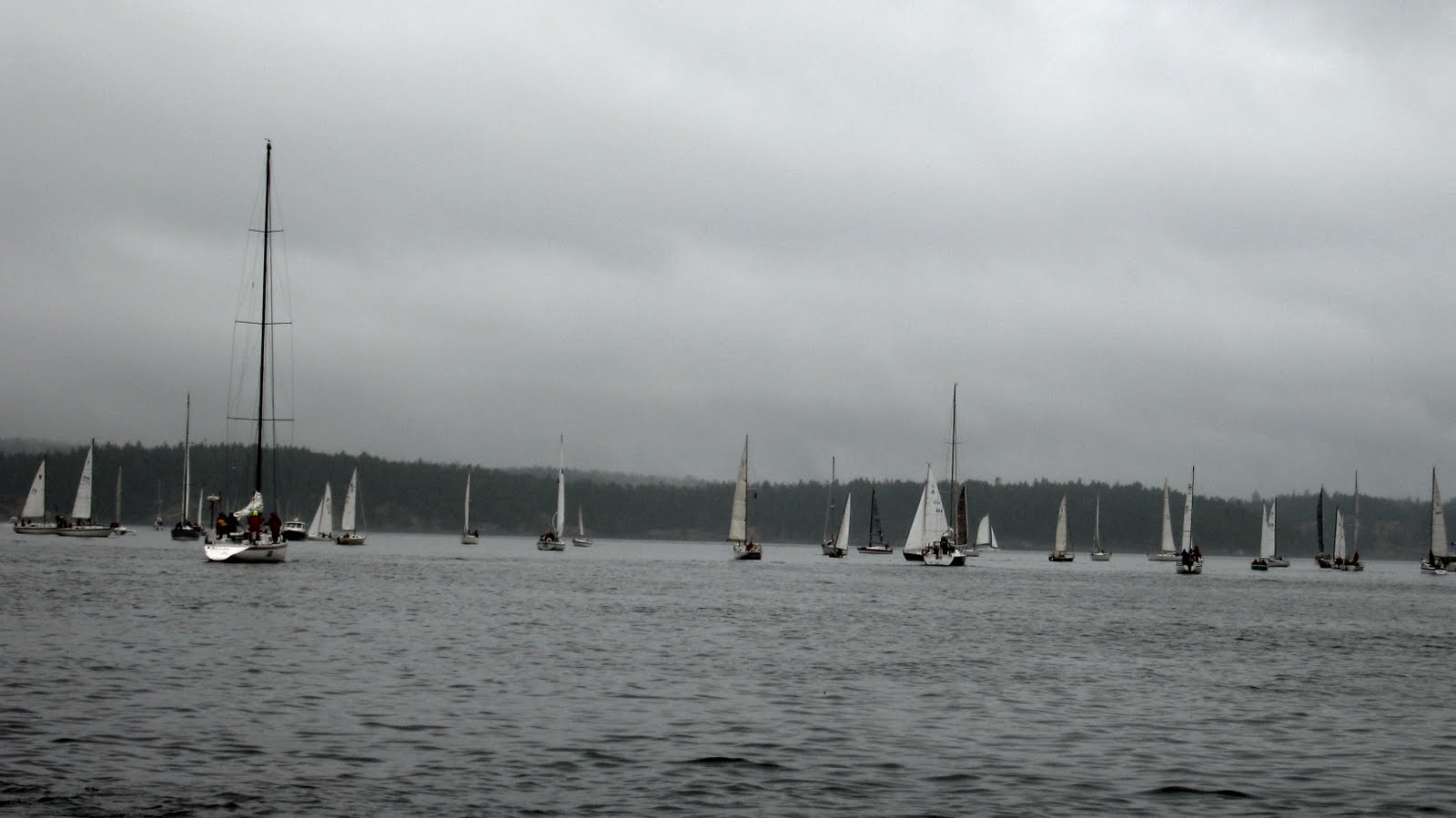
Sunday Racing in Friday Harbour
Next day we were up again early and motoring toward Port Townsend. We made sure we were with the tide and moved along quite smartly until we reached the end of San Juan Island and the entrance to the Straits of Juan de Fuca. Although the wind picked up slightly, it was the amazing waves that really caught our attention – big swells rolling in over shallow water from the west, tide rushing out between the islands and wind waves forming from the east. We held on and after an hour cleared this confused area. We were able to set all our sails and had a great run across the Straits in partly cloudy skies.
We had read that when you approach Port Townsend, the experienced sailor is wary of the rip tide around Point Wilson. We were watching the tides carefully and knew we would be in no danger. Nevertheless, as we approached the point and the lighthouse, the waters rose up as if a giant gold seeker was panning for gold. Ripples and whirls just magically appeared and started to toss Ka’sala around. We could see that this disturbance was in a very confined area of the water and that local craft seemed to be able to discern its boundary. We plugged through and tied up at the Point Hudson Marina late in the afternoon. Point Hudson in the foreground
 Ka'sala at Point Hudson
We knew we would be staying in Port Townsend for a while, for this is where we would be collecting our new mainsail and Yankee from Carol Hasse at Port Townsend Sails. The Point Hudson marina offers a discount to boats who are doing business with the sail loft and we wanted to take full advantage of it.
We had both been to PT several times in the past. We had passed through a few times on our motorcycles catching the ferry for Whitby Island and then Doug had stayed there for a few weeks a couple years ago to help Mel receive Iridium when it was shipped up from San Francisco to be commissioned before crossing into Canada. I had joined him that time on my motorcycle, a weekend adventure from work in Comox, that consisted of a very quick sprint down Vancouver Island, and an interesting ferry ride to Port Angeles, before continuing on. We both love this town with its broad streets, excellent brew pubs, marine shops and used bookstores. The town has been well kept up and its Victorian buildings are in great shape. This is a thriving town and its new marine trade school at Point Hudson, which trains many people in the various boat building arts, is a real feather in the town’s cap. Ka'sala at Point Hudson, in front of the Northwest Marine Centre
We stayed at Point Townsend for four days while Doug took off the old mainsail and Yankee. We certainly had a strong feeling of nostalgia as we took those worn sails off – many lovely sailing miles for us and untold miles for Peter and Marlene. These sails had been through the Panama Canal after all!! We gave them to Port Townsend sails that have a whole recycle program going to make sure nothing is wasted, so we felt better when we found that out. Off with the old sails!
When the sails were off, Doug went up the mast, and lubricated the sail tracks to get ready for the new sails. The new sails fit perfectly and went on with no problem, though their stiffness was amazing compared to the easily pliable old sails. On inspection, Carol Hasse decided we would be better off to have a reinforced area on the Yankee to give it extra strength if it rubbed against the spreaders. Our new mainsail is loose footed, meaning it is not attached to the boom along the bottom, but is fully batoned and has two reefing points. Our new Yankee has a more accommodating cut with a coloured cheater strip to save the edges from too much UV.
Prepping for the new sails , Port Townsend Sails loft in background Doug with Carol Hasse
We were very pleased with the sails and the service Port Townsend Sails were able to give us. Hasse's sail loft is an extraordinaryly lovely place to work with high large windows, soft rock playing in the background, pictures and posters plastered around the walls, happy people gainfully employed. Everyone was friendly and accommodating answering all the questions we asked and obviously proud of the work they do. Cutting and sewing sails
While at Point Hudson, Doug went up the mast again and installed the deck lights which had broken in a storm while Ka’sala was tied at the Comox Marina. At the navigation station he installed the AIS (Automated Information System) which would give us warning and details of ships in our vicinity.
On the fourth day we moved down to the Port of Townsend Boat Haven so we could fuel up, provision and prepare ourselves for our upcoming ocean passage. There is a big new Safeway through the boatyards about three blocks away and we were pretty excited about getting the groceries we wanted at a fair price. We filled a shopping card and shanghaied it back to the marina to off load our supplies. We got quite a few looks as we made our way across the boatyards – ah, this is what it feels to push a shopping cart around! The upside of it was we passed a local brewery and discovered that from 5 – 8 that evening there would be live music in their garden and specials on their beer. Too irresistible! Afterward we made our way down to the local smokehouse and bought ourselves a rack of slow cooked ribs….mmmmmm. Our favourite
Next morning, another early rise and out onto the Straits of Juan de Fuca again. There was heavy fog, but we felt confident with our radar and new AIS system. The radar worked well, but we discovered the AIS antenna was not installed correctly and did not give us sufficient warning when the Port Townsend ferry passed nearby us. Knowing the AIS was not working in the heavy fog led Doug to make a decision to stay out of the shipping lanes. Unfortunately it meant that we were back into the Point Wilson caldron and this time it gave us a real going over with waves up to six feet roaring this way and that. Ka’sala, under power, stayed under control, but we certainly had a rough ride before exiting that very unsettled piece of water. However we did see hear quite a few ships blowing their foghorns that day. The fog stayed with us the rest of the day and we ended up motoring most of the way to Port Angeles where we spent the next uneventful night.
The following is taken from my journal on August 15: “We were up early this morning – socked in fog – but we needed to leave right away as the tide was in our favour. Around Port Townsend, the currents run 3 knots so we don’t want to go against them. That meant we gave our radar (and the new AIS system) a good work out. I steered, Doug watched the radar, then we traded off. We had very little wind and at some points the seas were quite rough so we got tossed around a couple of times, nothing the hearty Ka’sala couldn’t handle – or her hearty crew for that matter! (har har matey)
We got in to Port Angeles about 3pm. We’re alongside a dock, about ½ a mile from town and we may take a walk in after dinner. The fog is just a bit off shore and I expect there will be a lot of it tomorrow too. We want to get up very early (5 to leave for 6) and try to get to Neah Bay near Cape Flattery. It will be a long day, but we need to leave before the wind builds later in the day. No chance of sailing as the wind is expected to come directly on our bow. Not only that, because the wind comes directly from the ocean, the seas build too. We want to be tucked in before that happens! There are a couple places along the way we can nip in to if we have to. A lot of this worry will be gone when we are at sea as a lot of the sea state and wind problems are the result of the land. I also cannot get over how COLD the water is – 10 degrees! It doesn’t get that cold in Courtenay in the middle of the winter!!!
All is going exceptionally well and we are very pleased with Ka’sala and with ourselves. Each day is an adventure and brings a new challenge or two that we seem to be taking in our stride and overcoming. Each day we build more confidence. I think a lot of it is because of all that we learned on Caperata (mostly what NOT to do!). We’re older, more mature and less impetuous (well, maybe) and Ka’sala is a premier little ship. “ (Caperata was the name of the Brewer 44 centre cockpit we lived aboard and sailed for four years in Hong Kong)
On August 16 we made our way from Port Angeles to Neah Bay. We started in fog, but it quickly lifted and we sailed beautifully for the rest of the day with, surprisingly, eastern winds – not something that happens in that stretch of water very often – and arrived at the dock in Neah Bay early that evening.
From my journal August 17: We arrived at Neah Bay late yesterday afternoon from Port Angeles. We thought we might only get as far as Clallam Bay, but as luck would have it, the wind shifted directions and started blowing from the East. That meant it literally pushed us out the Straits. We sailed for most of it, but had to motor some too. It was the first time I had experienced rolling ocean swells and I found them most comfortable. The boat just coasts up and down them very gently. The highest they got was about 6 feet. It was the first time with our new sails – they went up cleanly and worked well. We even reefed the main (made it smaller) as the winds built up to about 25 knots, before calming down again.
This place would be paradise for Dad. We spent last night in the marina – it is absolutely chock full with fishermen – we were the only sailboat. I guess the sockeye salmon are running like crazy – 100 percent better than last year and everyone is happy. The smell of fish guts and seagull guana overpowered everything. I didn’t have enough nerve to ask if I could buy some fish and, ironically, there are no stores that sell it! Instead, we had to satisfy ourselves with some smoked salmon (ah, poor us!) that we picked up today – fresh out of the smoker – mmm.
We also went to the Makah nation cultural museum this morning. (It’s all reservation here.) These native people (who claim lineal connections to the Kwakuitils of Alert Bay), have lived here for a very long time. About 500 years ago there was a mudslide in one of their villages that preserved all kinds of artifacts from that pre-contact time. They have most of them displayed in the museum and it was most interesting to read their history and see these exhibits. They are known for hunting whales and we saw the canoes and weapons they used to do it. Unbelievable that 8 men would get in a tiny boat and go out on the ocean to spear a whale! But they did, and they caught many. They must have been tremendously fearless and motivated. Now this reservation looks a bit rundown – the people are friendly, however, and many of them seem to be working hard to re-establish their pride in their culture.
We decided to take today as an R&R day before we head out tomorrow. Both of us were pretty tired last night and thought having a down day would only make us stronger for our passage. Needless to say, we are enjoying it. The weather is gorgeous and warm – I am writing this in my bathing suit in the cockpit. We have been able to see all the weather maps and get all the information for the next week and it looks like it will be tremendous for us – Doug says he couldn’t have wished for anything better. What a relief that is! So just before lunch we left the dock, went to the fuel dock, loaded up the boat and jerry cans (we have almost enough to motor the whole way if we had to!) and then headed out to anchor off. It is a lovely bay and I love being on the hook. We had an excellent lunch in the cockpit. After that we did the final prep of the decks and below. We’re really ready to go!
I was looking through the USCP Pilot Book for the American west coast this afternoon and it says it is 683 nautical miles to San Francisco from here. We will need to go farther than that as we can’t really follow a rhumb (straight) line, but it means about 7 days. So all going well we should arrive in SF next Sunday or Monday.
Vancouver & a Visit Home, July 28 to August 8
False Creek is a beautiful place to anchor a sailboat for a while. The harbor authority allows transient yachts to stay for 2 weeks and we took full advantage of it. Like the barbican to some fantasy castle, the Burrard Street bridge is the entryway to the charming lagoon within. Passing under the Granville Street bridge, by the False Creek Yacht Club on one side and Granville Island on the other, the passage opens up to a long wide body of water surrounded by sky scrapers, parks, bicycle paths and the Olympic Village, with mountains looming in the distance. It is truly a wonderful spot.
 False Creek Lagoon
By launching the dinghy we had ready access to all downtown Vancouver had to offer. Halfway down False Creek is Stamps Landing where sailors can leave their dinghies under the dock for free. Everything a mariner needs is within easy walking distance and the new transit system allows ready access to all parts of the city including the airport for just a few dollars.
 Stamp's Landing
I packed my bags to fly home to Ontario to visit family and celebrate my Dad’s 80th birthday, while Doug remained behind to work on Ka’sala, catch up with old friends and enjoy the city life. For $2.50 I rode the subway to the airport and was picked up by my sister, Darlene, in Ottawa, a few hours later.
 No, this is not how Darlene picked me up at the airport!
It was a great break for me to see my family – the first time I had been home in two years. I spent time in Ottawa with my sister and in Westport with my parents, before all of us packed up and headed off to our summer cottage in Plevna for the big celebrations.
 Sunset at the cottage
It was wonderful to have my immediate family, Mom, Dad, Darlene, her husband John and kids Ryan and Sean, and my brother Wes with his daughter Mackenzie. Also there to celebrate was my dear Uncle Jack, my Mom’s brother, and Aunt Mary, his wife, along with their son Paul, his wife Sherry, and their two rambunctious kids Ryan and Aiden. A bonus was to see my cousin Doug Lord with his son Andrew and daughter Frances. The weather was great, we all swam, were entertained by the kids, caught up with each other and ate lots of great food!
 Happy Birthday, Dad!
 Mom
Mom
 Uncle Jack & Aunt Mary
 The Coleman Clan: Wes, Mom, Mackenzie, Dad, me, Darlene,Ryan & Sean.
Ten days passed quickly and I was on the airplane back out to the coast to continue the Ka’sala adventure. While I was gone, Doug had taken the opportunity to paint all the insides of the lockers within the boat and the cockpit making these usually dingy places very bright and easy to clean. In the hot weather, the smell must have been ferocious! What price for a comfortable boat?
 False Creek Lagoon
By launching the dinghy we had ready access to all downtown Vancouver had to offer. Halfway down False Creek is Stamps Landing where sailors can leave their dinghies under the dock for free. Everything a mariner needs is within easy walking distance and the new transit system allows ready access to all parts of the city including the airport for just a few dollars.
 Stamp's Landing
I packed my bags to fly home to Ontario to visit family and celebrate my Dad’s 80th birthday, while Doug remained behind to work on Ka’sala, catch up with old friends and enjoy the city life. For $2.50 I rode the subway to the airport and was picked up by my sister, Darlene, in Ottawa, a few hours later.
 No, this is not how Darlene picked me up at the airport!
It was a great break for me to see my family – the first time I had been home in two years. I spent time in Ottawa with my sister and in Westport with my parents, before all of us packed up and headed off to our summer cottage in Plevna for the big celebrations.
 Sunset at the cottage
It was wonderful to have my immediate family, Mom, Dad, Darlene, her husband John and kids Ryan and Sean, and my brother Wes with his daughter Mackenzie. Also there to celebrate was my dear Uncle Jack, my Mom’s brother, and Aunt Mary, his wife, along with their son Paul, his wife Sherry, and their two rambunctious kids Ryan and Aiden. A bonus was to see my cousin Doug Lord with his son Andrew and daughter Frances. The weather was great, we all swam, were entertained by the kids, caught up with each other and ate lots of great food!
 Happy Birthday, Dad!
 Mom
Mom Uncle Jack & Aunt Mary
 The Coleman Clan: Wes, Mom, Mackenzie, Dad, me, Darlene,Ryan & Sean.
Ten days passed quickly and I was on the airplane back out to the coast to continue the Ka’sala adventure. While I was gone, Doug had taken the opportunity to paint all the insides of the lockers within the boat and the cockpit making these usually dingy places very bright and easy to clean. In the hot weather, the smell must have been ferocious! What price for a comfortable boat?
Subscribe to:
Posts (Atom)